


Cart 0
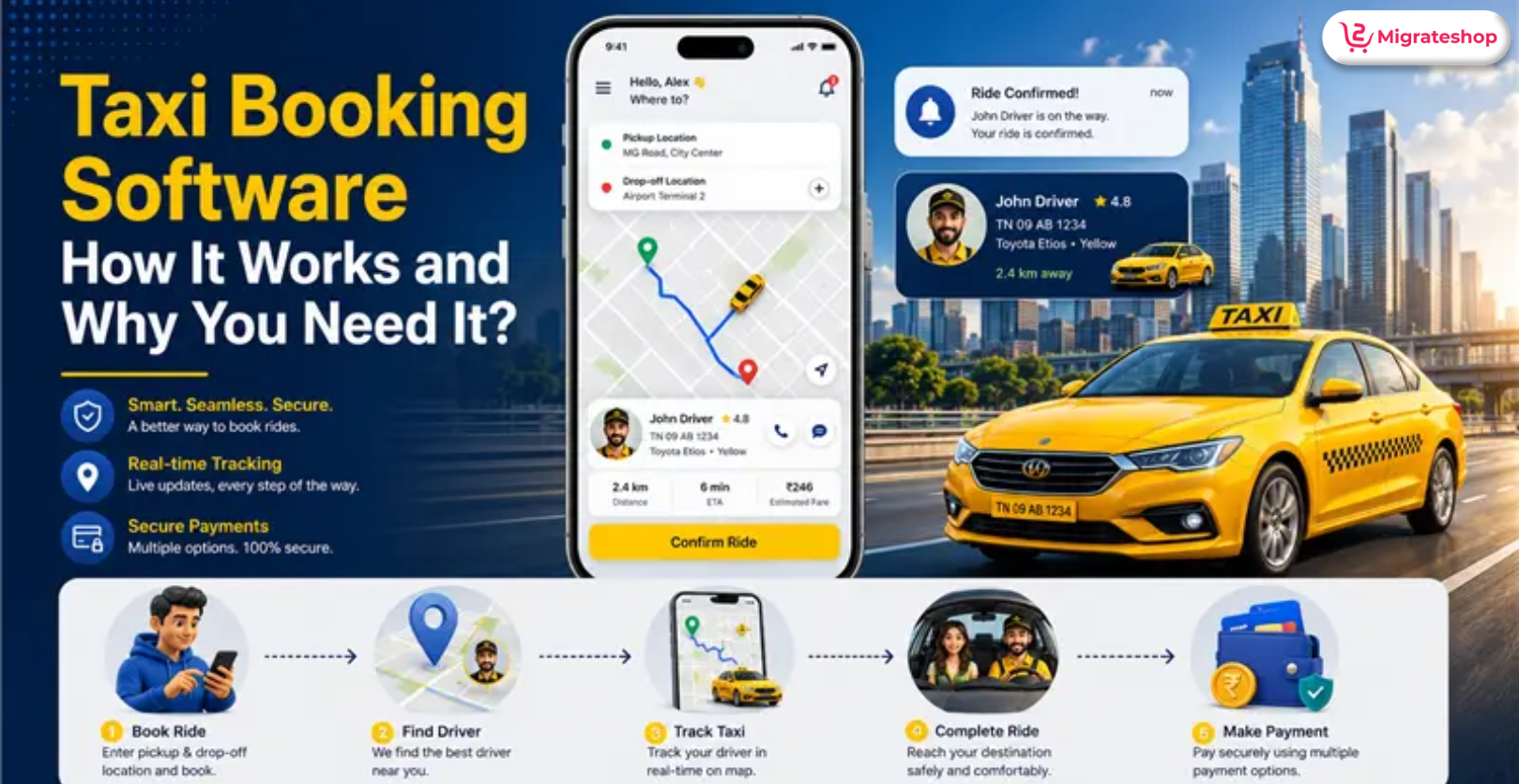
The taxi industry has evolved significantly with the rise of smartphones, digital payments, GPS technology, and on-demand transportation. Today, customers expect more than simply finding a taxi—they want quick bookings, transparent pricing, real-time tracking, multiple payment options, and reliable service.
For taxi companies and fleet operators, meeting these expectations requires the right technology. This is where taxi booking software comes into play.
However, with numerous solutions available in the market, choosing the right platform can be challenging. Before investing in taxi booking software, it is important to understand its features, benefits, costs, scalability, and other essential factors.
What Is Taxi Booking Software?
Taxi booking software is a digital platform that helps taxi businesses manage bookings, drivers, customers, vehicles, payments, and daily operations from a centralized system. It typically includes customer-facing applications or websites, driver applications, and an admin dashboard.
The software automates much of the booking process. Customers can request a ride, select their pickup and drop-off locations, view estimated fares, track drivers, and make payments.
Meanwhile, drivers can receive ride requests, navigate to passengers, update trip statuses, and manage their earnings.
For business owners, the admin panel provides tools to monitor operations, manage fleets, analyze performance, and handle customers and drivers.
Why Do You Need Taxi Booking Software?
Traditional taxi operations often depend on phone calls, manual dispatching, and paperwork. These methods can become inefficient as the business grows. Taxi booking software replaces many manual processes with automation.
A well-designed solution can help businesses:
- Accept bookings 24/7 through digital channels.
- Automatically assign rides to suitable drivers.
- Track vehicles and trips in real time.
- Reduce booking and dispatching errors.
- Provide customers with accurate fare estimates.
- Support digital and cashless payments.
- Manage driver availability and performance.
- Generate reports for better business decisions.
- Improve customer satisfaction and retention.
For growing taxi companies, the right software can transform daily operations while reducing administrative workload.
List of Key Features in Taxi Booking Software
Not every taxi booking platform offers the same functionality. Before choosing a solution, evaluate the features that are most important for your business.
1. Customer Booking App
The customer application should make booking a ride simple. Essential features include account creation, location selection, ride scheduling, fare estimation, driver details, booking history, notifications, and ratings and reviews.
A smooth user experience can directly influence whether customers continue using your service.
2. Driver App
Drivers need an application that allows them to accept or reject trip requests, view passenger details, use navigation, update ride status, communicate with customers, and monitor earnings.
The app should be easy to use because drivers interact with it throughout their working day.
3. Admin Dashboard
The admin dashboard acts as the central control system. It should allow administrators to manage customers, drivers, vehicles, bookings, payments, pricing, promotions, and reports.
Real-time operational visibility is particularly valuable for businesses managing large fleets.
4. GPS Tracking and Navigation
GPS integration enables businesses and customers to track vehicles during trips. Accurate location tracking also helps with driver allocation, route planning, estimated arrival times, and fleet monitoring.
5. Multiple Payment Options
Customers increasingly prefer flexible payment methods. Depending on the market, your software may need to support cash, credit and debit cards, mobile wallets, bank transfers, or other digital payment methods.
Make sure the platform supports secure payment processing and provides clear transaction records.
6. Automated Driver Dispatch
Automated dispatch can match passengers with available drivers based on factors such as location, availability, vehicle type, and other business rules. This can reduce waiting times and improve fleet utilization.
7. Scheduling and Advance Bookings
Some customers need rides immediately, while others want to schedule transportation for later. A good taxi booking platform should support both on-demand and scheduled bookings.
This feature can be especially useful for airport transfers, corporate transportation, and recurring customers.
Custom vs. Ready-Made Software
One of the biggest decisions is whether to purchase ready-made software or develop a customized platform.
Ready-made software is generally faster to launch and may require a lower initial investment. It can be a practical option for startups and small-to-medium-sized operators.
Custom software, on the other hand, allows businesses to build features specifically around their operational requirements. It can be more expensive and take longer to develop, but it may offer greater flexibility and scalability.
The right choice depends on your budget, business model, growth plans, and technical requirements.
Security and Data Protection
Taxi booking software handles sensitive information such as customer details, payment information, trip records, and driver data. Security should therefore be a major consideration.
Ask potential providers about data encryption, secure authentication, payment security, access controls, backups, and vulnerability management. You should also understand how the provider handles data privacy and regulatory requirements in the markets where you operate.
Scalability Matters
Your software should be able to grow with your business. A solution that works for 20 drivers may not be suitable when your fleet reaches 500 vehicles.
Before choosing a platform, ask whether it can support additional drivers, vehicles, service areas, booking volumes, administrators, and new transportation services.
Scalability can prevent the disruption and expense of replacing your entire technology platform as your business expands.
Customer Support and Maintenance
Technology problems can directly affect bookings and revenue. Reliable technical support is therefore essential.
Check whether the provider offers customer support during your operating hours, emergency assistance, software updates, bug fixes, documentation, and ongoing maintenance.
Final Thoughts
In conclusion, Choosing taxi booking script is more than selecting a booking application. It is a technology investment that can influence your operational efficiency, customer experience, driver productivity, and long-term growth.
Start by identifying your business requirements and defining the features you cannot compromise on. Compare different providers based on functionality, scalability, security, pricing, customization, integrations, and support—not just the initial cost.
The best taxi booking software is ultimately the one that fits your current operations while giving your business enough flexibility to adapt and grow in the future.

You may also like

Boost Your Taxi Business with Advanced Features of an Uber Clone
Boost Your Taxi Business with Advanced Features of an Uber Clone
The taxi booking industry has undergone a significant impact in the past few years. And...

From Ideas to Reality : Understanding the Concept of Uber Clone
From Ideas to Reality : Understanding the Concept of Uber Clone
In the rapidly evolving realm of technology, where innovation fuels progress, the notion of an...