


Cart 0
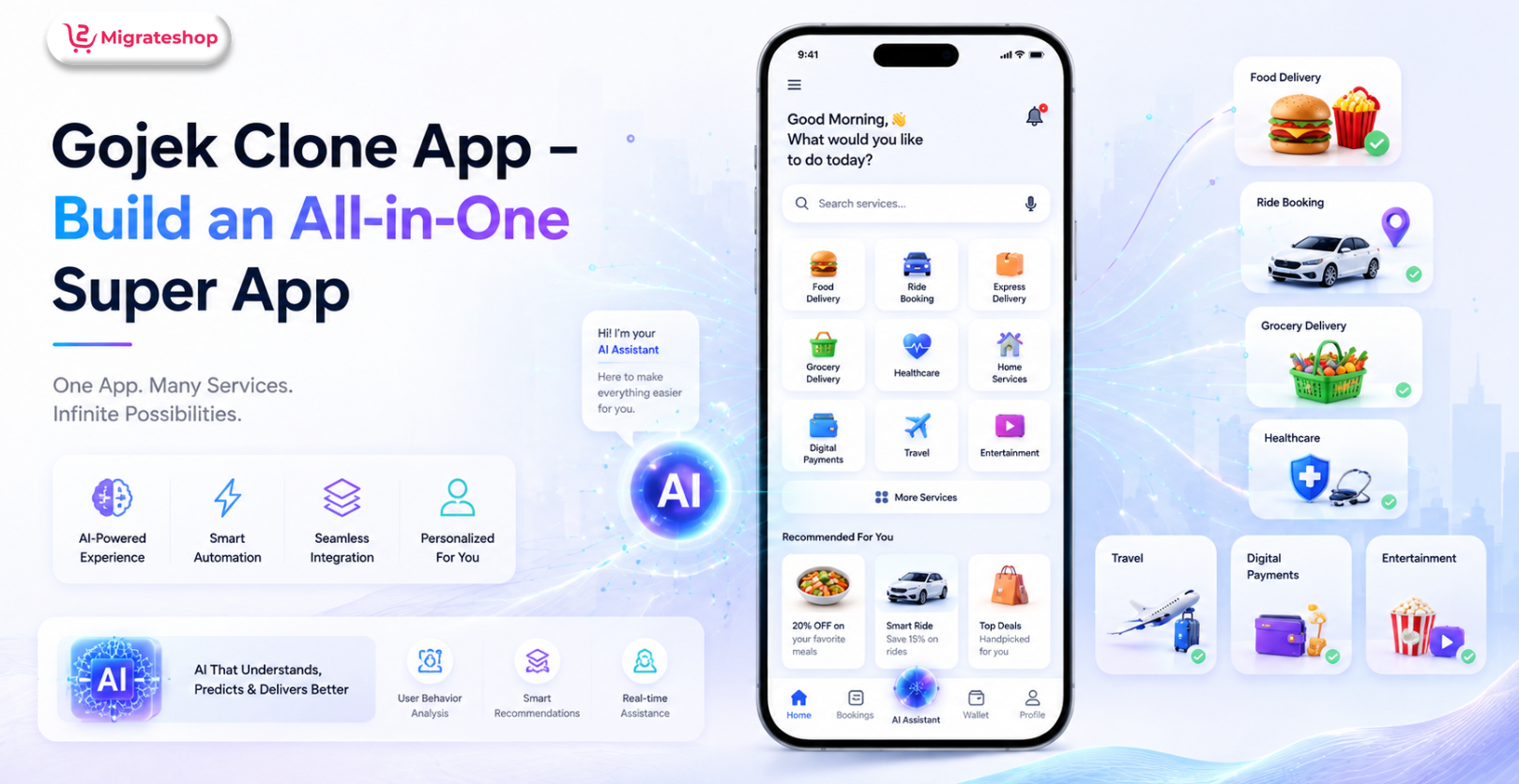
The multi-service platforms have altered the way that people receive their day-to-day services. Users can access transportation services, food delivery, grocery, parcel delivery, rentals and much more from a single digital space with on-demand services, without having to download multiple applications.
With these platforms expanding, the management of multiple services, users, vendors, delivery partners and service providers becomes complex. Ai is making new opportunities here. Intelligent technologies can be used to enable platforms to provide more relevant experiences, help customers find services more easily, support customers, and enhance selected business processes.
The true potential lies not just in incorporating Ai as a new feature. Businesses must determine where “intelligent” functions can provide effective solutions to real customer or business problems.
Why Intelligent Technology Matters for Multi-Service Platforms?
Various interactions are dealt with through a multi-service platform on a daily basis. Customers book/corder products and services, vendors manage products/services, delivery partners fulfil orders, and the administrator manages the whole ecosystem.
These activities can be effectively handled by traditional systems, but with growing platforms, they tend to produce huge information and increasingly more complex workflows. This information can be analyzed by intelligent technologies and can support the selected processes.
Some of the possible use cases are recommendations, assistance, service discovery, automation, and business insights.
The value will vary based on the implementation of these capabilities and if these capabilities are responding to a relevant business requirement.
What Businesses Should Consider Before Implementation?
Implementing smart technology is not as simple as simply choosing a tool and plugging it into an app.
- The first step in problem-solving is identifying the problem. Then they should consider if the information required is available, reliable and suitable for the purpose.
- Security and Privacy are also critical. Businesses must have an appropriate level of protection for customer information, location data, transaction information, and operational records with multi-service platforms.
- The other factor is integration. New capabilities should integrate with old applications, databases, APIs and workflows, not give an isolated experience.
- Last but not least, businesses should assess results. The successful implementation should lead to a clear improvement in customer experience, operational efficiency, decision support or some other measurable business benefit.
- Multi-service platforms will continue to be more and more personalized and responsive in the future.
- By facilitating customer interactions through conversational interfaces, businesses can improve user experience.
- Recommendation systems can aid users in finding the relevant services, and automated workflows can help businesses with repetitive activities.
But, it will require the judicious use of the technology and not just the adoption of the technology for intelligent gadgets just because they are in vogue.
It’s important for businesses to start with specific use cases, test their effectiveness, keep tracking and continually improve.
Multi-Service Businesses can get supported by How Migrateshop in what ways?
Migrateshop provides a customizable multi-service platform that brings multiple service categories into a connected digital ecosystem.
Solutions can be adopted for business models such as ride-hailing, food delivery, grocery delivery, parcel delivery, e-commerce, and rentals, and others that are on-demand. Users of different roles can have their own exclusive interfaces.
AI integration is also possible to boost automation and user experience, and the solution can be tailored to the specific needs of any business, depending on their brand, target audience, services, and operating model.
When considering an intelligent multi-service platform, it’s important to understand businesses need to define their requirement first and then assess what capabilities have the most practical value.
Conclusion
AI is opening up new opportunities for multi-service super app, including support for personalization, service discovery, customer support, automation, and business analysis.
The very best approach isn’t to add technology into everything. Rather, companies need to concentrate on real customer and operational problems and add intelligent features where they can add tangible value.
With the development of multi-service ecosystems, a flexible platform and smart features can help businesses build more intelligent, connected and scalable digital experiences.

You may also like

Gojek Clone App: A Complete Guide to Building a Multi-Service Super App
Gojek Clone App: A Complete Guide to Building a Multi-Service Super App
In the modern digitalized economy, the user must get convenient, fast, and numerous services in...

Gojek Clone: The Ultimate Solution for Your On-Demand Service Business
Gojek Clone: The Ultimate Solution for Your On-Demand Service Business
In this fastest and evolving digital world, convenience is king. Also, most people are looking...