
Cart 0
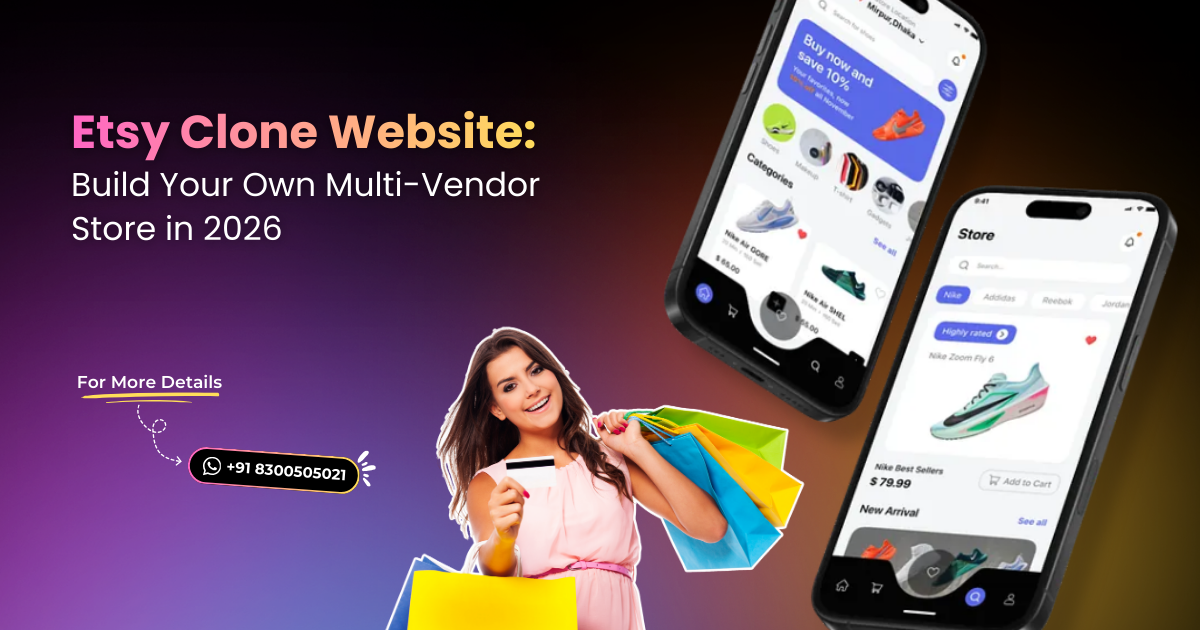
The online business world is changing at an unparalleled rate. Creativity, community, and digital entrepreneurship are thriving—and platforms like Etsy continue to demonstrate that the multi-vendor approach can be powerful. However, this is the fun part: this time around, you do not require a huge development budget or a complete engineering team to create your own variant of Etsy.
With pre-made marketplace products (such as the one Migrateshop provides under the name Etsy Clone), artificial intelligence features, and customization that fits any business, anyone will be able to open their own multi-vendor store in 2026, branded fully, owned fully, and made for your niche.
Herein this guide, we will go through how one can create an Etsy clone website, what you will require, why the multi-vendor concept is becoming popular, and how modern technology makes it easier than ever before.
What Is an Etsy Clone?
An Etsy Clone is a ready-to-go, customizable software platform (script or application) that enables entrepreneurs to create their own online multi-vendor-based marketplace with the exact functionality of Etsy, such as product listings, secure payments, seller profiles, and product reviews, but under their name. It offers a turnkey basis, and time and money are saved on development, and the emphasis is placed on creating a niche community.
Core Concept:
Ready-Made Platform: This is where a template with the fundamental functions of a marketplace is ready-written instead of being written directly.
Multi-Vendor Marketplace: This is where any number of sellers may become members, open shops, add products, and transact sales, and the buyers go to the market to shop and buy from many different sellers.
Brandable: You can customize it, modify designs, introduce additional features, and create it to fit certain niches (e.g., local artisans, digital art, sustainable products).
Key Features:
Seller Tools: Item listing, inventory, shop customization, and performance.
Buyer Tools: filter/search, wishlist, secure checkout, product reviews, messaging.
Admin Panel: User management, order tracking, analytics, and revenue management.
Payment: Pay securely with built-in payment gateways and shipping.
Benefits:
Faster Launch: It saves a lot of time to market as compared to construction.
Cost-Efficient: It is cheaper compared to the development.
Niche Focus: Well-adaptable to particular markets (e.g., environmentally friendly, local products).
What Is Meant by an Etsy Clone Website?
An Etsy clone site is a ready-made, customizable software system with features that are similar to those of Etsy, enabling entrepreneurs to create their own multi-seller business based on the concept of a unique, handmade, vintage, or craft marketplace without coding it themselves.
Key Aspects
Ready-Made Script: It is a ready-to-run codebase, which offers the fundamental structure and capabilities of Etsy.
Multi-Vendor Marketplace: This is created to accommodate multiple sellers so that they can create their respective shops on your site.
Scalable: The design, branding, and features can be changed to suit a particular business concept or market segment.
Basic Features: It contains user accounts, product listings, search, reviews, secure payments, and tools of the seller.
Advantages: It is cheaper and faster than the process of custom development and provides faster launch and scalability.
Why Construct an Etsy-Like Marketplace in 2026?
The proposed Etsy-type marketplace in 2026 is an appealing business because the trend of personalized products with the strong demand would remain, and niche-based e-commerce is on the rise.
The emergence of user-friendly development tools and the need to have a genuine and community-oriented shopping experience leave new platforms with a lot of opportunities.
Important Motivators to create a Niche Marketplace in 2026
Tapped Niche: Although general e-commerce is a multi-billion dollar market dominated by companies such as Amazon, vertical or niche marketplaces focused on a particular category can draw a loyal following that does not find complete service on general e-commerce.
Craving Authenticity: The millennials and Gen Z appreciate the idea of making purchases in support of small businesses and independent creators.
A marketplace of handmade or vintage items can provide authenticity and a personal touch, which customers are seeking, and it is hard to achieve in items produced on a massive scale.
Availability of Technology: More than ever before, starting a multi-vendor platform is a cheaper and less difficult endeavor.
Ready-made solutions are offered by stand-alone marketplace constructors or e-commerce sites based on multi-vendor apps, thus avoiding significant coding and initial investment.
Scalable Business Model: The marketplace owner is an intermediary that is able to facilitate transactions with sellers, taking care of inventory and shipping.
This model is very scalable, less manual, and has a number of possible revenue sources (commissions, listing charges, optional subscriptions, and advertising).
Unsatisfaction of Sellers with Current Site: A portion of current Etsy sellers complain of rising prices, growing competition, and poor branding opportunities, which make them pursue other platform options that are less seller hostile or their own personal sites.
This is what makes a vacuum of a new marketplace that is focused on seller needs and community building.
Cashing in on Trends: Trends in the market in 2026 are individualized presents, online downloads, and a particular aesthetic, such as Chateletcore and MIDImalism.
These new trends can be exploited by a new marketplace that provides a customized platform on which sellers in these high-demand categories can sell their products.
Working on an Etsy Clone Marketplace?
An Etsy clone website is a marketplace that operates on the principle of a customizable and multi-vendor platform (usually via a pre-built script) where individual sellers can post handmade, vintage, or craft items; customers can browse, buy, and review them; and the services earn revenue through a listing/transaction fee or advertisements.
Seller Onboarding: Sellers register, design a profile, define the style of their shop, and add products with images and descriptions, prices, and shipping choices (processing time and costs).
Buyer Experience: Buyers browse/filter products (by type, seller, and price), make a purchase (add to cart/wishlist), shop (live chat), and make a secure purchase.
Platform Management (Admin): This is an administrator-facing dashboard, which coordinates all the users, vendors, transactions, commissions, refunds, and even listing promotions.
Payments and Payouts: Integrated gateways help in conducting transactions; the seller gets earnings (less fees) through the associated bank accounts, and the withdrawal management tools are frequently included.
Monetization: The platform makes money through listing fees, a percentage of transactions, subscription fees, or the placement of premium advertisements to sellers.
Key Features
Multi-Vendor Architecture: It permits a large number of sellers, rather than a single seller.
Product Listings: Rich product pages that have pictures, product descriptions, and variations.
Searching and Sorting: Advanced search to locate certain items with ease.
Ratings and Reviews: Develop trust that is useful in facilitating buyer decisions.
Seller Tools: Order and sales and performance dashboards.
Customization: The possibility to brand the platform and seller shops.
Mobile-Friendly: Works with different gadgets.
How It Works (Business Model)?
To Entrepreneurs: Launch a niche or general market with a ready-made “Etsy clone script” (software) that will be developed quicker and cheaper than a bespoke one.
Streams of Revenue: Sales On Commission, Listing Fees, Premium Seller Features, Advertisements.
Growth: The more sellers, the better (network effect), and it forms a lively community of unique goods.
Core Features Included on Your Etsy Clone Website
A clone site of Etsy must have powerful features and functionalities to serve three key types of users: buyers, sellers, and the administration. The main business model will be based on the development of a multi-vendor marketplace of unique, handmade, and vintage products.
For Buyers
The purchasing experience must be user-friendly, interactive, and safe, and it must be easy to find and buy products.
User Authentication: Easy create/sign-in features, such as social media engagement, to create and manage an account.
Powerful Search and Filtering: This has powerful search features with category, price, location, product options (size, color, custom options), and specific seller or shop searches.
Personalization: Intelligent product suggestions and a customized home page with the help of AI, depending on the behavior of the user, and improvements in the shopping experience.
Shopping Tools: A shopping cart, wishlists (or favorites), purchase history, and an option to add many delivery addresses.
Safe Payments: Multiple, safe payment gateways (e.g., Stripe, PayPal) should be integrated, which will allow working with multi-currency payments and automatic tax management.
Order Management: The processes are able to monitor orders in real-time, receive updates on the status of orders, and process a return or a refund.
Communication & Reviews: In-app messaging, i.e., to directly talk to the buyer/seller, and a system to review product and seller ratings/reviews to create trust.
For Sellers
A seller should have effective means to run his or her online stores, goods, and orders.
Customizable Storefronts: Seller-specific dashboards and shop URLs that can be custom-branded, bioed, and have policies.
Product Management & Inventory: simple interfaces to list products with rich media (images, videos), to manage inventory/stock level, and even to upload items in large amounts.
Order Fulfillment: The means of controlling the incoming orders, approving or rejecting orders, tracing the dispatch, and managing shipping logistics.
Promotions & Marketing: In-tools to allow sellers to make their own sales, use coupon codes, and control advertisements on their listings.
Financial Dashboard: It is a place where earnings, payouts, and commission fees imposed by the platform administrator are viewed.
For the Admin
The administration dashboard is the main point of tracking and regulation of the whole marketplace’s functioning.
Detailed Dashboard: To keep an eye on the activities of the site, sales tendencies, and the main performance indicators.
User & Content Management: The equipment to regulate and verify user (buyer and supplier) accounts, approve or disapprove product postings, and regulate site content and categories.
Payment & Commission Management: Commission percentages are easily established and automated to facilitate sales and payment flows, as well as financial reporting.
Analytics & Reporting: Connections with such tools as Google Analytics to learn more about how customers behave and how business works to make informed decisions based on the data.
Promotional Tools: Ability to establish site-wide banners, discounts, and run marketing campaigns.
Critical Underlying Characteristics
Responsive Design: The site and application should be able to deliver a smooth experience to all experiences (desktop, tablet, and mobile).
Security: Intense security measures, such as the use of SSL encryption and fraud prevention to protect user data and transactions.
Scalability: The architecture of the platform must be designed to support the future increase in the number of users, products, and transactions.
Multi-Language and Multi-Currency: The site should also have different languages to cater to a global audience in various currencies.
Step-by-Step Process: How To Build an Etsy Clone Website?
The Etsy clone is built in the following patterns: planning (niche, model, research), design (UI/UX, wireframes), development (using code or no-code), and integration (payments, Stripe/PayPal, shipping).
High levels of testing and strategic launch (marketing, onboarding sellers), with the first stage being a Minimum Viable Product (MVP) with the bare minimum functionality (user account, listings, cart, checkout), then levels of advanced functionality (reviews, chat, AI suggestions).
Phase 1: Planning & Strategy
Niche/Market Research: Find out what you cover (e.g., vintage, digital art) and what is in the competitors’ to determine what it does not cover.
Business Model: Agree on the creation of a stream of money, like a listing fee, a sure transaction fee, and premium seller quality.
Basic Functions: They will include user registration/log in, product list (seller-side), search/browse (buyer-side), shopping cart, checkout, secure payment, basic profiles, and order management.
Phase 2: Design & Development
The buyer and seller experience is created with the help of the visual aesthetics (color, font, and layout) and the wireframing Sketch screen flows (wireframes), and design.
Choose Your Tech Stack:
No-Code: Bubble refers to a platform on which it is feasible to develop a database infrastructure and procedures.
Code/Script: A Script can be a marketplace script or can be created by developers.
Database Building: Construct the categories of information that constitute Users, Shops, Products, orders, etc. (e.g., product name, price, seller ID).
Specifications: User authentication, shop creation, product uploading, product dynamic created page, search, cart, and checkout.
Features: Gives the opportunity to add payment in Stripe, PayPal, and shipping services.
Phase 3: Testing & Launch
The functionality (bugs) of the test, the test performance, the test security, as well as the test user experience on the devices.
Beta Testing (Optional): Collect the responses from the early improvement Customers.
Launch (MVP): The first one is the platform.
Marketing and Onboarding: Create attraction of buyers and sellers by use of SEO, social media, and content marketing. Attention to recruiting your first sellers.
Phase 4: Post-Launch & Monitoring
Follow-Up/Evaluate Trace the user actions, the sales, and the comments.
Enhancement Scale: Add high-premium functionality, including reviews, AI suggestions, in-app chats, and multi-language support on the basis of user and business development.
Why Migrateshop’s Etsy Clone?
The Etsy Clone of Migrateshop is economical and rapid to develop with a high feature count. A multi-vendor marketplace with 100 percent possession of the source is optimal when the businessperson feels there is an opportunity in the handmade/unique goods market.
The motives for why it is better to utilize the Etsy Clone offered by Migrateshop are significant:
Simple & Lower Start-up Cost: It is a cheaper, faster marketplace and built with a quick solution, which is based on existing, open-source software.
Complete Customization: Have the source code and perform 100 percent branding and customize the product to the specs.
Multi-Vendor: Find a solution that will encourage a few sellers to sell their products on a single location, and buyers will have access to an enormous amount of unique and handcrafted products.
Mobile-Ready: Native Android and iOS apps are listed in order to reach more people and engage them with more attention.
The features are numerous: Multiple payment gateways, languages, a search engine-friendly site, and an administrator panel to have full control of the site.
Full Support: Support in posting applications in the app store, support, and installation.
What You Get:
The basis of a successful e-commerce enterprise.
The place to develop your brand and seller/buyer network.
Expand to grow your business.
Essentially, Migrateshop is a catalyst to develop your own Etsy-like marketplace within a relatively brief frame of time, i.e., with both the necessary tools and support and a focus on business expansion, instead of the hassles of its formation.
Conclusion
In conclusion, the Etsy clone site belongs to the most lucrative and intelligent business opportunities that can be created in 2026. The appropriate technology, be it a custom or an existing one, such as the Etsy Clone offered by Migrateshop, can help you to build a marketplace that fits your brand, serves your niche, and becomes a successful digital ecosystem.
It’s high time that you take it, and your marketplace can be the next Etsy in your niche.

You may also like
How Technology Helps Startups Launch Faster with Clone Scripts
How Technology Helps Startups Launch Faster with Clone Scripts
The process of launching a startup is not only interesting but also accompanied by a...
How White-Label Clone Scripts Save Time and Money for Startups
How White-Label Clone Scripts Save Time and Money for Startups
One of the most important factors of success in the competitive environment of tech startups...

Top 10 Creative Business Ideas for Young Entrepreneurs
Top 10 Creative Business Ideas for Young Entrepreneurs
Starting a business as a young entrepreneur can feel both thrilling and frightening. With the...