


Cart 0
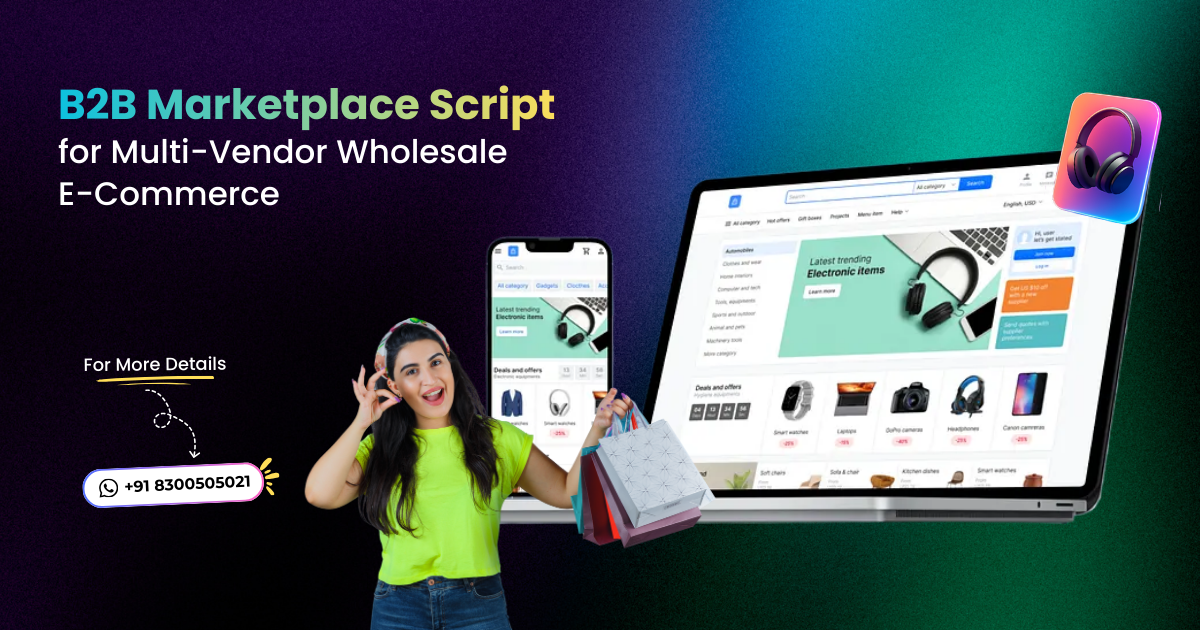
Over the past couple of years, there has been a sudden shift in the world of B2B (business-to-business) e-commerce. As an increasing number of businesses move to online methods of buying goods and services, B2B marketplaces have become necessary in bridging buyers and sellers. The concept of B2B marketplace script the importance of them, and their functioning to help the buyer and the seller to transact smoothly will be discussed in this blog post.
We shall delve into the properties and advantages of using such a script, the technology behind it, and how to create a successful multi-vendor wholesale e-commerce site with the assistance of a B2B marketplace script.
What is the B2B Marketplace Script?
A B2B Marketplace Script is a pre-written software that has been developed to help businesses create and start their own online marketplace to conduct B2B e-commerce.
It offers the core code and capabilities required to establish a multi-vendor marketplace where businesses can purchase and sell products and services to each other, which has become the foundation of platforms like Alibaba or IndiaMART. The scripts will be a time- and money-saving alternative to developing a platform.
The Advantage of the B2B Marketplace Script in Wholesale E-Commerce: The use of a B2B marketplace script in wholesale e-commerce is advantageous, as it offers a more economical, time-saving, and scalable alternative to starting up an internet marketplace.
Scripts provides a ready-to-use, battle-tested framework with the key B2B capabilities, such as quantity ordering, discounts, and simplified vendor and transaction management, helping a business enter the market at a faster rate without having to develop it in the initial stages.
The Benefits of a B2B Marketplace Script
Shorter Time to Market: An established script enables a business to start in a short time, which saves a lot of time and effort as compared to script customization.
Affordable: It is cheaper than developing an entire platform since it does not require the use of a lot of development tools and infrastructure expenses.
Customizable: Although the script offers a solid foundation, it can be tailored to a particular business need, and it may not be difficult to fit in with the other software.
Inbuilt B2B Capability: Scripts have inbuilt B2B capabilities such as bulk ordering, customer-specific prices, and the capability of supporting sophisticated tax and payment systems.
Scalability: The software will be scalable, thus able to expand with the business as its needs develop.
User-Friendly: The scripts are designed to be easy to use and do not require any coding knowledge by administrators, vendors, or clients, and are designed to streamline more complex tasks such as order and vendor management.
Efficient Management: With scripts, many complex B2B functions, like order processing, payment processing, and vendor management, are automated, and the business owner does not have to work hard.
Automatic Upgrades: It has automatic software upgrades that ensure that the solution is future-proof and that the platform is up-to-date with the current requirements of the market and current technologies.
Major Characteristics of a B2B Marketplace Script
The main attributes of the Alibaba clone are multi-vendor control, advanced search and listing of products, secure shopping cart and checkout with a variety of payment and shipping methods, and strong buyer and seller control over orders.
Other important functions include elaborate administrative dashboards and communication solutions such as messaging and RFQ systems, among other management tools such as analytics, inventory, and review/rating systems.
For Buyers and Sellers
User Registration and Profile Management: It enables users to create accounts and manage their profiles.
Multi-vendor Storefronts: Allows other vendors to be independent in their own storefronts, where they can list products and take orders on their own.
Product Catalog: The sellers can add products with descriptions, variations, and media.
Advanced Search and Filtering: Buyers can filter and find products easily using search and categories, and advanced filters.
Shopping Cart and Checkout: A typical online shopping system that has numerous options, as well as payment and shipping.
Order Management and Tracking: Buyers and sellers are provided with the possibility to track orders, manage inventory, and deal with returns.
Reviews and Ratings: This is a buyer-to-buyer rating and review of products that builds trust and transparency.
Communication Features: Buyers and sellers have built-in messaging and chat applications where they can communicate.
Wishlist Option: This feature enables customers to store goods to use for a later purchase.
The Administrators
Admin Dashboard: A hub of administration of users, vendors, products, and orders.
Vendor management: Approving, managing, and monitoring tools on the platform.
Product Management: A summary for the administrator to control any product in the market.
Payment and Commission Management: Supports the integration of payment gateways and can be used to support various payment and commission schemes.
Analytics and Reporting: Gives insights and reports about sales, user activity, and additional important metrics.
Discount and Coupon Management: Promotional offer creation and management tools.
Advanced
Bulk orders and Quotes: Such functions as bulk orders and quotes are important in B2B marketplaces.
Tiered Pricing: Will enable the vendors to price variably depending on order quantity.
Multi-language and Multi-currency: Assists an international audience in using the site.
Shipping and Tax Management: This is a tool to set shipping rates, shipment tracking, and taxation, such as VAT or GST.
Seller Checks and KYC: An option to check the authenticity of sellers.
Developing an effective Multi-Vendor Wholesale E-Commerce with our B2B Marketplace Script
To establish an effective multi-vendor wholesale e-commerce system, one needs a strategic approach, and this includes proper planning, appropriate technolog,y and proper management of the marketplace environment.
The cycle can be divided into a number of important phases, starting with the original idea, followed by the introduction and success.
I. Preparation and Planning
Define Your Niche and Target Audience: Calculate a particular deficiency in the wholesale market. Rather than competing with such giants as Alibaba instantly, target a niche that is under-serviced (e.g., specific industrial equipment, organic bulk food, or regional handicrafts).
Totally identify your targeted businesses (buyers) and manufacturers/distributors (sellers).
Select a Business Model: The operations will be influenced by your revenue model.
Common Options Include:
Commissions: It is easy to make a percentage of each transaction, and this can be scaled.
Subscription Fees: Paying vendors a monthly or annual subscription fee to use the platform and have more premium features.
Advertised Listings/Ads: This is an option where the vendors are allowed to pay a fee to have increased visibility.
Value-Added Services: The logistics, analytics, or financing.
Carry out in-depth Market Research: Research competitors, market trends, and the exact pain points of your target buyers and sellers.
Your value proposition will be informed by this research, and initial traction will be built.
II. Platform Development
One should choose the right technology. The options are customized and ready-made.
Custom Development: offers the most opportunities for flexibility and control to unique B2B requirements, but is more expensive and requires more time to develop.
Ready-built Software/SaaS: Sharetribe, CS-Cart, or WordPress plug-in (i.,e. Dokan on WooCommerce) can be implemented fast and reduce start-up expenses.
Minimum Viable Product (MVP): This is a process where one launches a product with the bare minimum functionality (user registration, product listing, product payment processing) and develops it according to the feedback.
III. Key Features
An effective platform should support the particulars of the administrators, suppliers, and purchasers.
Admin: Centralized dashboard, vendor approval workflows, commission management, content management system (CMS) and reports and analytics as well as fraud protection.
Vendor: Customized storefronts/profiles, easy-to-use dashboards, batch product importations, automatic inventory updates, order management (integrated shipping), tax management, as well as analytics.
Buyer: Simple registration, high-tech search and filters, integrated shopping cart (with more than one vendor), multi-payment possibilities, order tracking in real time, and a powerful rating/reviews service.
IV. Launch, Growth and Management
Onboard Quality Vendors: Find the sellers that are reliable, emphasizing the value proposition of the platform and making the registration easy. Such incentives as discounts on early adopters can make a difference.
Install Trust Infrastructure: Establish trust between the buyers and sellers and the platform with well-defined rules, verification, secure purchase (via such solutions as the Stripe Connect or PayPal) and proper dispute resolution mechanisms.
Market Strategically: Employ the tools of SEO, content marketing, email marketing, and social media to bring buyers and sellers on board.
Monitor and Optimize: Monitor performance (e.g. customer acquisition, vendor performance, conversion rates) on the basis of data and analytics. One should constantly get feedback to detect the bottlenecks and make the user experience better.
Scalability Plan: Make sure your platform has a high traffic, transactions, and vendor base without experiencing performance problems.
Conclusion
In Conclusion, the Multi-vendor wholesale e-commerce B2B marketplace script provides business with a great power to create an efficient, scalable and profitable online platform. With the introduction of the appropriate features, orientation on the user experience and strategic marketing, businesses are able to establish a successful marketplace that bridges the gap between buyers and sellers within the wholesale market.
You may be an entrepreneur who just starts a new business, or you may be a well-known company that needs to grow and expand its business and in this case, an investment in a B2B marketplace script can be the success you need in the competitive business environment of a wholesale e-commerce.
With the increased number of businesses moving to online services to conduct bulk purchases and sales through online means, it is the ideal moment to create your own multi-vendor B2B marketplace and leverage on this emerging trend.

You may also like
Take your business to the next level with B2B eCommerce solution
Take your business to the next level with B2B eCommerce solution
B2B eCommerce solution is the platform that enables businesses to establish an online storefront, manage...
Best B2B Alibaba clone script to bring your B2B trading startup
Best B2B Alibaba clone script to bring your B2B trading startup
The B2B eCommerce Business Model simplifies the whole business activities between companies, wholesalers, and resellers....
5 Benefits of Building B2B eCommerce Website with B2B Portal Script
5 Benefits of Building B2B eCommerce Website with B2B Portal Script
B2B Portal script is an eCommerce marketplace software that can be used by entrepreneurs to...