
Cart 0
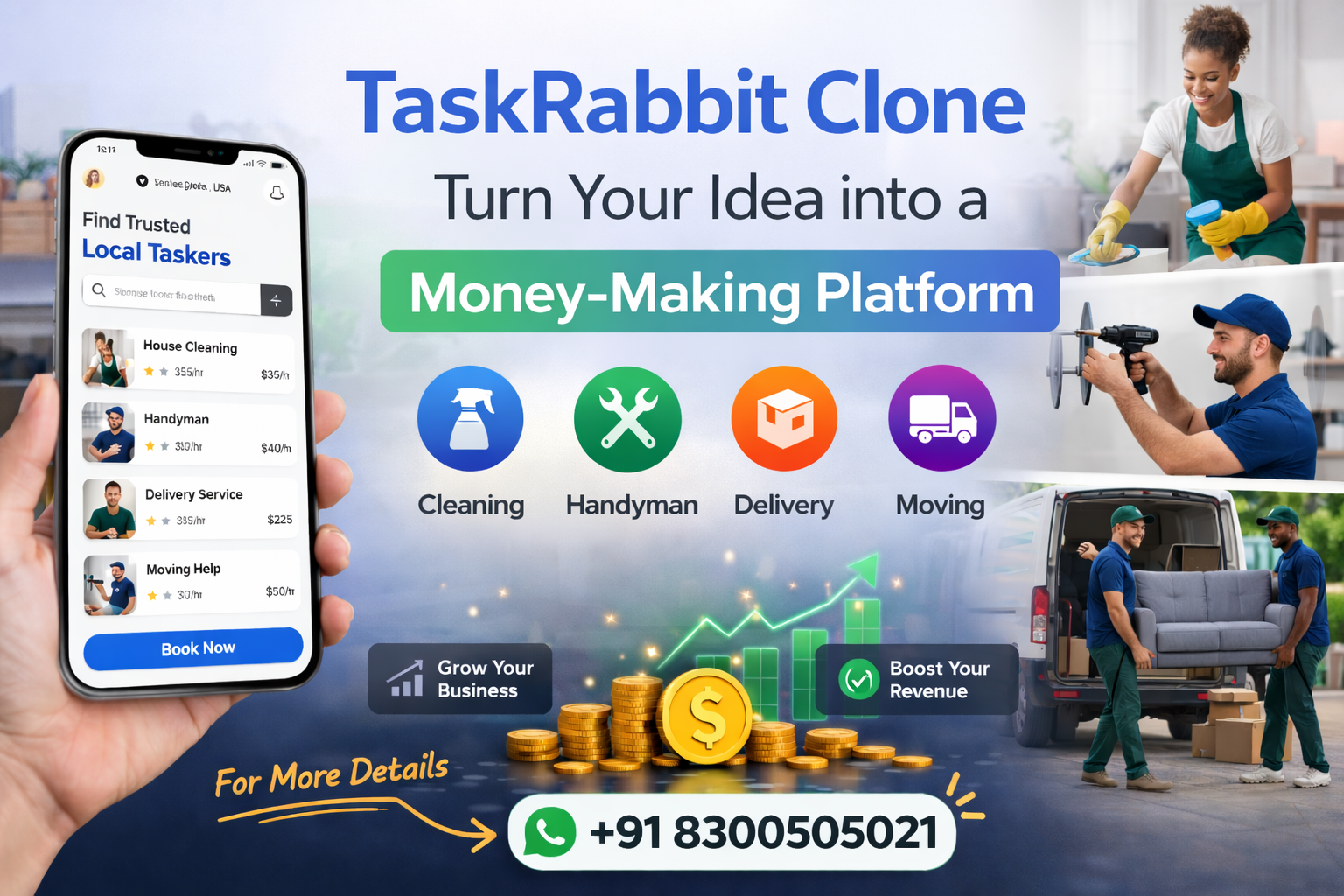
The gig economy has ceased to be a trend; it has become a worldwide movement that is transforming service delivery and consumption. Whether it is domestic services or professional-specific services, people are now keen on convenience, speed, and flexibility rather than the traditional employment models. And in the case that you have ever considered starting a service-based platform, then a TaskRabbit clone solution could be the quickest and most intelligent way to the top. You do not need to create everything on your own, but rather take a ready-made platform that is ready to scale, monetize, and provide a smooth user experience.
We will discuss all that you need to know, including how a TaskRabbit-like business operates, its features, advantages, revenue models, and how to transform your idea into a business that will make you money.
Table of Content
- Learning the Task Marketplace Model
- What is TaskRabbit Clone Solution?
- The Reason to start a Task Marketplace Business in 2026?
- Core Features of Taskrabbit Clone Solution
- Taskrabbit Clone Revenue Module
- Advantages of a Taskrabbit Clone Solution
- How can I make my Idea a Money-Making Platform?
- TaskRabbit Clone Revenue Models
- Conclusion
Learning the Task Marketplace Model
A task marketplace is an online service that matches third party service consumers (e.g., handyman work, freelancing, delivery) with independent service consumers (taskers). Working as a sharing economy intermediary, the platform handles listings, payments, and trust (reviews) and collects fees/commissions to facilitate transactions, e.g., on TaskRabbit.
The Fundamental Elements of a Task Marketplace:
Two-Sided Audience: The model needs the presence of supply (taskers) and demand (customers).
Platform Operator: This is the organization that controls the app/website, establishes standards, and manages the process of KYC (Know Your Customer).
Transactions and Monetization: Generally, revenue is obtained by commission fees charged on completed work, service fees, or membership fees.
Mechanics of Trust: Systems such as ratings and reviews play a vital role in quality control because the system does not directly employ the service providers.
Key Models & Types:
Peer-to-peer (P2P): Person-to-person, such as task-oriented.
Vertical Specific: Sites specialized in a single industry (e.g., DoorDash in food).
Closed/Curated: Higher quality control through restricted providers, i.e. Pro platforms.
Benefits & Challenges:
Advantages: Scalability is high, there is no inventory holding, and the range of services is large.
Cons: Since it is difficult to appeal to both parties at the same time, there is strong competition, and it requires efficient technology.
What is a TaskRabbit Clone Solution?
A TaskRabbit clone solution is an existing, ready-to-use, and customizable software platform that emulates the model of on-demand service marketplaces, matching users to local service providers to perform tasks such as cleaning, handyman jobs, and moving. It is a fast, affordable, white-labeled solution to creating a platform.
The following are the main elements of a TaskRabbit clone solution:
User App (iOS/Android): It will have such features as browsing services, hiring, secure payments, and tracking activities.
Provider App (iOS/Android): Gives the service providers the ability to sign up, take jobs, schedule hours, and earn money.
Admin Panel: This gives in-depth access to users, providers, service categories, and revenue commission tracking.
Basic Strengths and Capability:
Service Bidding/Booking: Customers post an advert, and contractors bid or can choose between fixed/hourly rates.
Real-time Tracking & Chat: In-app chat, SMS notification, and location tracking of real-time updates.
Scheduling: This helps to book immediate or future services, including recurrent booking of services.
Safe Pay Gateway: Accepts various payment methods, such as credit cards and electronic wallets.
Reviews & Ratings: A system to establish trust and be able to sustain the service quality.
Typical Applications and Markets:
Handyman Services: Plumbing, electrical, and furniture assembly.
Home Cleaning: Family cleaning.
Logistics & Moving: Moving, lifting, and courier.
Personal Assistance: Dog walking, personal shopping, and errands.
Freelance Marketplace: Freelancers and freelance-based tasks.
The Reason to start a Task Marketplace Business in 2026?
A task marketplace is a high-potential business with a booming freelance economy where more than half of the U.S. workforce will be independent, combined with AI-driven efficiencies, starting in 2026.
Marketplaces will succeed through the matching of high-demand local services, like pet care, smart-home installation, and renovation, with those who are seeking curated and trusted providers. The reason to make 2026 the ideal year,
Freelance Workforce Surge: With about 86.5 million individuals freelancing in the U.S. by 2027, the number of individuals available to supply talent into the service marketplaces will be enormous.
AI-Supported Scalability: AI-based tools can be used to create platforms that are more efficient, cheaper, and faster. AI can be used to automate matching, scheduling, and customer support, enabling small teams to operate on large networks.
High Demand for Trust and Safety: With deepfakes and AI-generated content making it difficult to trust, a trustworthy marketplace that filters and authenticates service providers (proof of realness) will have a major competitive advantage in 2026.
Emergence of Niche Specialization: The general marketplace is already overcrowded, but the more specialized local or vertical marketplace (such as in pet care or senior care) is set to take off.
Stable Economic Prospect: A good portion of the business leaders (73% in early 2026 forecasts) are optimistic about revenue growth, and this indicates promising conditions to launch new service-based platforms.
Key Strategies for 2026:
Emphasize creating a marketplace with “manual matching behind the scenes” first to guarantee quality, and emphasize niche areas, employ AI to coordinate the matching and operational processes, and observe.
Core Features of Taskrabbit Clone Solution
A TaskRabbit clone script is a turnkey solution that is developed to develop marketplaces based on on-demand services. Among other aspects, there is geo-location-based tasker searching, secure in-app payments, real-time tracking, enhanced search filters, and in-app chat messaging. It usually has a user, a service provider (Tasker), and an extensive admin interface.
Customer
Post Job Request: In our taskrabbit clone application, the customers are able to post a job request in case they do not find a service that is relevant.
Search Service: The search options allow the customers to discover services by keywords, by provider, by category and by price.
Chat Options: The customers can chat with the handyman/provider to get quick information or address queries.
Booking History: The booking history feature will allow customers to look at previous and current bookings.
Book a Service: On the taskrabbit clone, users can book a service they require at a given date and time.
Service Provider
Accept/Cancel: The Taskrabbit clone script helps handymen to make accept/cancel service reservations whenever they want.
Online/Offline: The handyman is able to change their status to available or unavailable by using online/offline mode.
Manage Handyman: In the TaskRabbit clone app, providers can manage all handymen listed in their account.
ID Verification: To authenticate, the service provider/handyman may post valid documents.
Bid For Jobs: In an app such as TaskRabbit, the service providers are able to bid on their own custom jobs posted by the customers.
Admin
Control Users: The administrator is able to control customer, provider, and handyman data through one potent Laravel administration pane.
Manage Coupons: The admin is able to see, modify, or add discounts to the on-demand service app.
Manage Transactions: Under the decided transaction section, the admin will be able to track all payments and cash payments, track earnings, and process service provider withdrawal requests.
Multi-Service Category: The admin is able to create and arrange categories and several services in the TaskRabbit clone application.
Manage Bookings: In the TaskRabbit clone app, the admin will have the ability to manage bookings, information, and status.
How can I make my Idea a Money-Making Platform?
To convert an idea into a money-making platform with a TaskRabbit clone, it is possible to launch a hyper-local, on-demand service marketplace based on ready-written software, where users can hire experienced employees (Taskers) to do the work.
Monetize through service fees (e.g.,) on job completions, registration fees, or premium listings. The main actions are determining a niche, incorporating secure payments, and introducing mobile applications.
TaskRabbit Clone: How to make a profitable business out of it:
Define Your Niche & Market: You should not compete directly, but instead, you should target a niche such as eco-friendly cleaning, rural handyman services, or tech support to create a loyal customer base.
Use Pre-built Clone Solutions: Jump-start development with provider-supplied clone scripts, such as Shipturtle, Appscrip, or Appkodes. These usually provide three-way (user, tasker, and admin) systems.
Essential Features:
User App: Search options, location search, reservation, online payment, rating/reviews.
Tasker App: Profile management, service listings, availability schedule, and earnings dashboard.
Admin Panel: User management, security verification of Tasker IDs, payment management, and dispute management.
TaskRabbit Clone Revenue Models
Task marketplaces (such as TaskRabbit or Fiverr) are also known to earn money by charging a commission fee (1030 percent per completed task), subscription fees to access premium service providers or featured listing fees to increase exposure. The best models to achieve sustainable growth and maximize revenue are the hybrid models, which combine commissions with paid advertising or lead fees.
Task marketplace primary revenue models,
Commission/Transaction Fees (Most Common): The site levies a percentage or flat rate on every transaction that is generally charged against the service provider, the buyer, or both. Examples are TaskRabbit and Fiverr.
Subscription/Membership Fees: Service providers pay a monthly or annual recurring charge to use the platform, have unlimited access to leads, or have lowered commission rates.
Lead Generation Fees: The platform does not charge a commission and instead offers a service provider a fee per lead (buyer request), which they respond to, whether they are awarded the job or not.
Featured Listings/Featured Ads: Service providers are required to pay a fee to have their profiles or bids featured, pinned, or ranked higher in search results, making them more visible.
Service/Processing Fees: This is a minor fee charged to the transaction price that the customer pays, commonly to pay the cost of processing the payment.
Hybrid Strategy Recommendations
The majority of prosperous marketplaces employ a combination of the models to spread the revenue:
Free: Basic membership with basic functionality, with premium enhancements on tools such as background verification, advanced analytics, and priority bidding.
Hybrid (Commission + Ads): A combination of a typical commission fee with sponsored promotion options for professionals to become special (e.g., Fiverr).
When selecting a model, the average ticket size of tasks and frequency of transactions should be considered so that the model fits the user behavior and market demands.
Conclusion
In conclusion, one of the most promising business opportunities in the present-day digital economy is the launch of a task marketplace platform. Having the right strategy, tools, and implementation, you can develop a platform that is not only able to solve issues in real life, but also bring in a steady stream of revenue.
A TaskRabbit clone solution provides the platform upon which you can save time, cut costs, and minimize risks. It is there that your success will be based on the extent to which you know your market, how you engage your users, and how you scale operations.
When you are willing to transform your idea into a source of money, you have the best time to do so. The demand is increasing, the technology is available, and the opportunities are unlimited.

You may also like

Kick Off Your Transportation Business With Our Taxi Booking Script
Kick Off Your Transportation Business With Our Taxi Booking Script
Are you looking to launch a profitable transportation business? It’s quite a thrilling endeavor, but...

What Makes a HomeAway Clone Script Stand Out in the Market?
What Makes a HomeAway Clone Script Stand Out in the Market?
In the rapidly growing vacation rental industry, launching your online rental platform to compete with...

Building Tomorrow: The Role of AI Technology in Shaping the Future
Building Tomorrow: The Role of AI Technology in Shaping the Future
The world is changing so quickly these days, and technology will always be a major...