


Cart 0
In the modern-day world, where everything is fast, convenience and speed are the main constituents of contemporary services. Digital platforms have changed the way individuals get their daily services, especially with food delivery and transportation services. Maintenance and repair of homes are not an exception. The emergence of the on-demand handyman app is changing how property owners and tenants approach repairs, installation, and maintenance services.
Users no longer have to take hours searching to find competent technicians, wait to receive calls, or bargain about prices, but can now book a competent handyman within seconds at the touch of several buttons on their smartphones. This is a smooth experience that is redefining the home services business and establishing a new standard of convenience, reliability, and efficiency.
This blog addresses the functionality of on-demand handyman applications, their main functionality, the advantages to users and service providers, and reasons why they are the future of repairing the house.
1. The Development of Home Repair Services
Home repair services started as an informal and local word-of-mouth handyman business, but it is now a multi-billion-dollar, tech-focused business of more than $500 billion.
The sector has previously been dependent on manual work and local directories, but currently, it has AI-based offerings, on-demand applications, and maintenance on subscription. This change is focused on digital transparency, speed, and specialized and environmentally friendly services.
Key Stages in Evolution:
Early 20th Century (Post WWII): DIY increased during the war since there were labor shortages, and thus the necessity to have versatile workers who could mend the DIY disasters of the weekends.
Late 20th Century (DIY Boom): With the emergence of large-box stores such as The Home Depot (1981), homeowners were able to do their own repairs, and the professional services were more organized.
21st Century (Digital Transformation): A new trend of aiding home services with apps like TaskRabbit and digital platforms that help the user book a vetted professional immediately came into play.
Modern Era (AI & Subscription): The industry is shifting to AI-powered on-demand services to achieve better speed and predictability. Regular, preventative, and on-call maintenance has been introduced in subscription models.
Future Trends: Dwelling on smart home technology integration, sustainability, and green building practices.
The demand in the industry is already increasing because of the old housing and increased mortgage rates, where homeowners are interested in renovating rather than purchasing new homes.
2. What is the On-Demand Handyman App?
An on-demand handyman app is a mobile app platform that connects homeowners and businesses to personnel near the area who can be hired to complete a repair, maintenance, or installation job on demand.
This type of app, like ride-hailing services, provides advantages through navigation services, booking immediately or making a reservation, monitoring the arrival of the professional, paying safely, and shedding light on the service.
These apps have several main characteristics and advantages, such as
Varied Services: The services offering assistance in plumbing, electrical, carpentry, cleaning, and appliance repair are available to the users.
Convenience & Speed: These platforms provide real-time, on-demand, or planned services to save time in locating, vetting, and recruiting assistance.
Clear Pricing and Booking: Customers can receive transparency of hourly, fixed, or upfront pricing on jobs.
Security & Trust: Built-in rating and review systems enable customers to choose professionals they trust, while secure payment gateways are built in.
Live Positioning: The users would be able to see the whereabouts of the professional and an approximation of the time of arrival.
The famous examples of such service models are programs such as TaskRabbit.
3. On-Demand Handyman App: How Do They Work?
On-demand handyman app (e.g., TaskRabbit, Handy) are a type of digital marketplace that pairs customers with licensed professionals to do home repairs, cleaning, and installations.
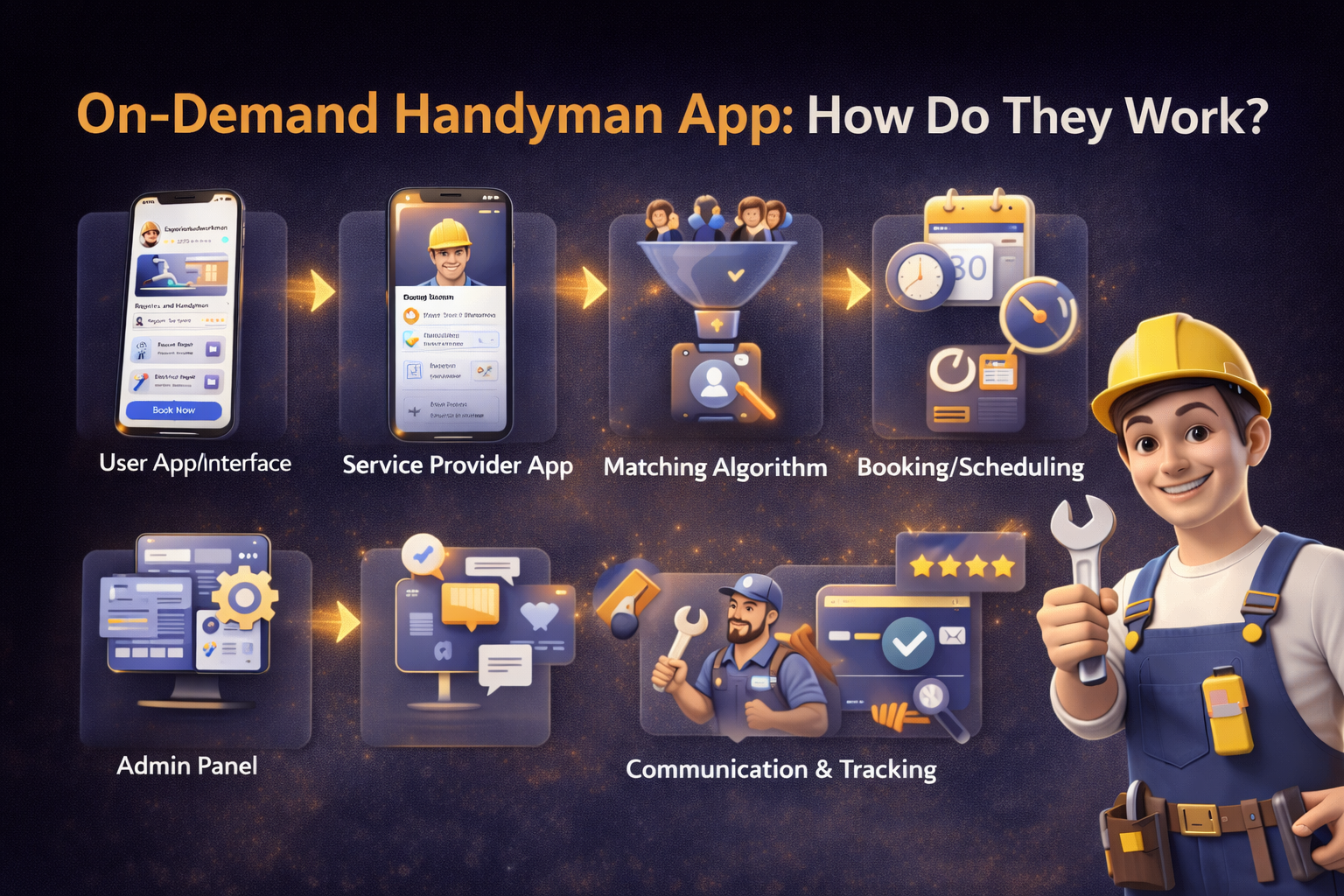
Users reserve services through the application, monitor professionals in real time, and pay safely. It includes user registration, service choice, matching by GPS, in-app communication, and review of the service post-service.
Basic Elements and Processes
User App/Interface: The customer registers, and they can choose services like plumbing, electrical, and cleaning and set an appointment time.
Service Provider App: Job requests are received by the verified professionals, who are then given or rejected depending on their availability.
Matching Algorithm: The application employs geolocation to pair users with qualified and local professionals.
Booking/Scheduling: Real-time scheduling eliminates the chances of booking twice, allowing one to book now or book at a later date.
Communication and Tracking: In-app chat will enable the sharing of job information, whereas GPS will allow the professional to be tracked.
Payment & Reviews: In-app payments (card, wallet, cash) are secured on completion, and a rating and review system is used to ensure quality.
Admin Panel: This is a back-end system that operators use to manage users, providers, and transactions.
Key Features for Efficiency
Clear Pricing: It refers to a pricing system that lets users view approximate or fixed prices before they book.
Certified Experts: Handymen are checked in terms of qualification and experience.
Automation: On-the-way status, booking, and completion automation.
Bendable Models: There are apps that are offered on a one-time basis and also apps that give subscriptions to those who use them frequently.
4.Key Features of an On-Demand Handyman App
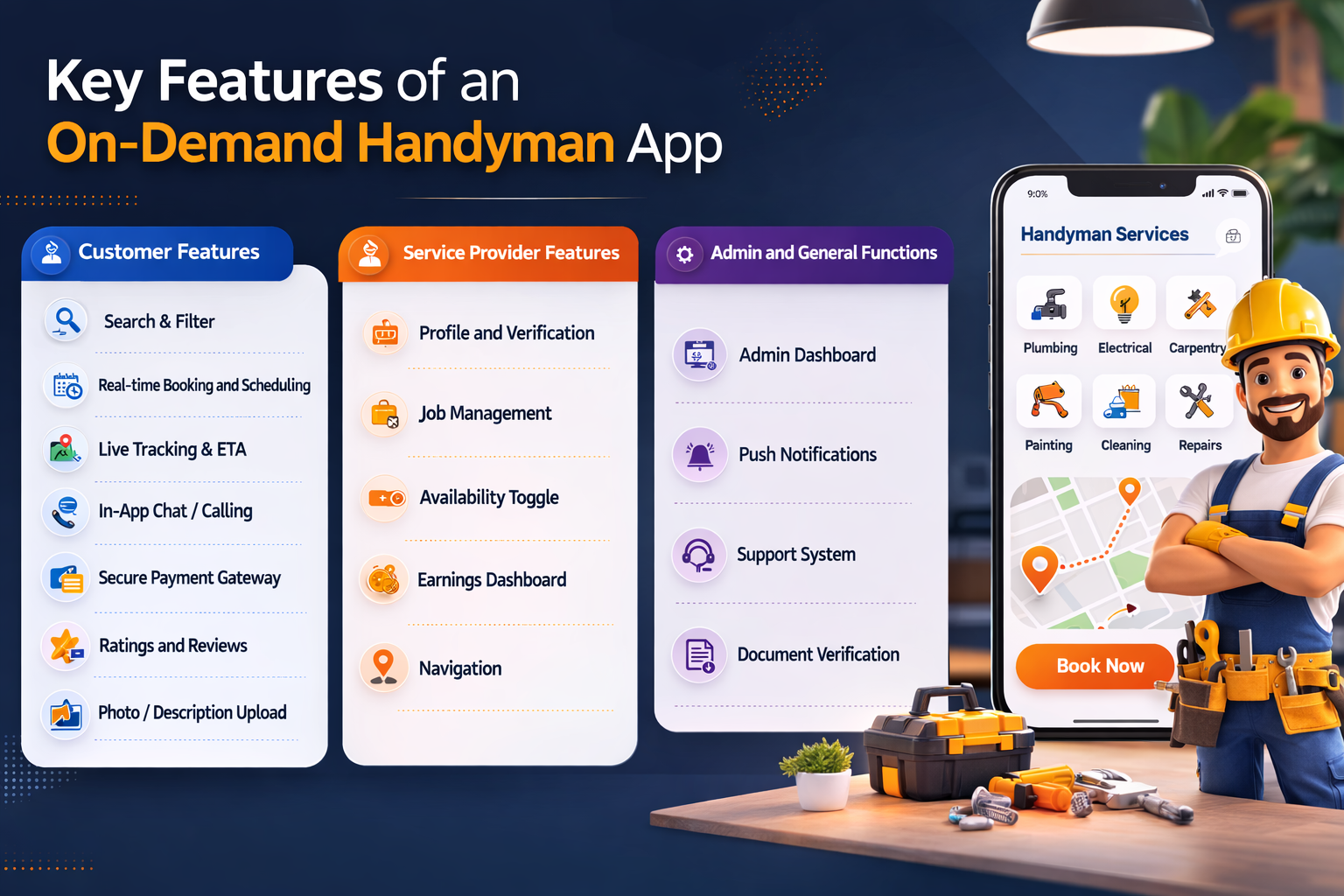
An on-demand handyman app must have a three-tier (user, provider, and admin) structure that is oriented toward real-time service, trust, and convenience.
It has major characteristics such as GPS proximity matching providers, real-time booking/scheduling, in-app payment, in-app chat, real-time tracking, and rating systems. It should include document validation to ensure security and a powerful admin panel.
Customer Features
Search & Filter: Choose the services according to the category, skills, rating, or place.
Real-time Booking and Scheduling: Real-time booking or scheduling to be booked later, like cancellations/rescheduling.
Live Tracking & ETA: Track the position of the service provider and his/her arrival time.
In-App Chat/Calling: Real-time, one-on-one contact with the handyman.
Secure Payment Gateway: There are several payment methods, such as credit/debit cards, UPI, and wallets.
Ratings and Reviews: Comments to create a reputation and quality.
Photo/Description Upload: Post photos to define the issue very well.
Service Provider Features
Profile and Verification: Post elaborate profiles with skills, experience, and post licenses to build confidence.
Job Management: Approve or decline job requests and day-to-day schedules.
Availability Toggle: Enter working hours and availability.
Earnings Dashboard: See daily, weekly, or monthly earnings and control wallets.
Navigation: GPS directions to the location of the customer.
Admin and General Functions
Admin Dashboard: Complete control center in terms of users, providers, and transactions.
Push Notifications: Real-time information about booking confirmation, arrival, and payment.
Support System: Artificial assistance with dispute resolution.
Document Verification: Administrator permission of the provider credentials.
These will guarantee a smooth and secure experience, comparable to such platforms as TaskRabbit, to establish trust and promote repeat use.
5. On-Demand Home Services Demand in the Market
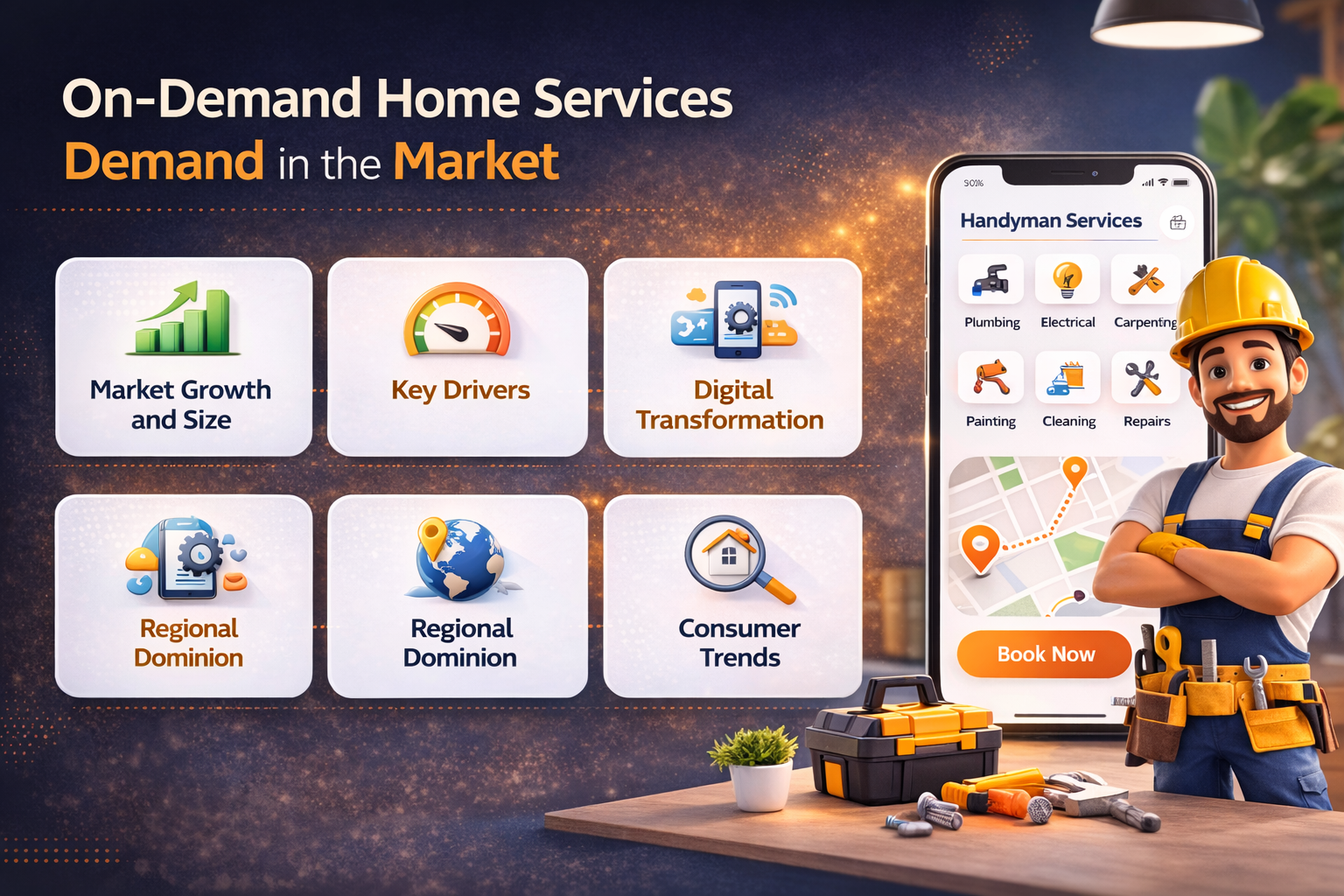
The international online on-demand home services market is enjoying phenomenal growth, with estimates showing that the market will increase by an average of 12.5% to 16.7%, translating to more than 4.3 billion to over 14 billion in the coming years, 2023-2024.
The reason behind this wave is urban and time-starved consumers in need of convenient cleaning, repair, and maintenance solutions assisted by apps.
Key Market Drivers & Trends
Market Growth and Size: The market is developing fast, with its projections indicating a possible 4.75 billion growth within the market between the years 2021 and 2026 alone.
The market in the U.S. is projected to hit 3.6 billion dollars by the year 2030.
Key Drivers: The main drivers of the high demand include the emerging gig economy, the rising use of smartphones, the higher disposable incomes, and the desire for convenience by the busy city populations.
Emerging Markets: The most sought-after is the home cleaning and repair (plumbing, HVAC), which is often perceivable due to the aging of residential houses.
Digital Transformation: In 2023, mobile-based platforms are the leading ones, and more than 68 percent of the market share is occupied by the availability of real-time tracking, transparent prices, and instant booking.
Regional Dominion: The Asia-Pacific region is taking the lead in terms of growth, and North America has a good portion of the world market.
Consumer Trends: The subscription-based model of recurring services is more preferred as opposed to making a one-time on-demand request.
6. On-Demand Handyman Apps Revenue Models
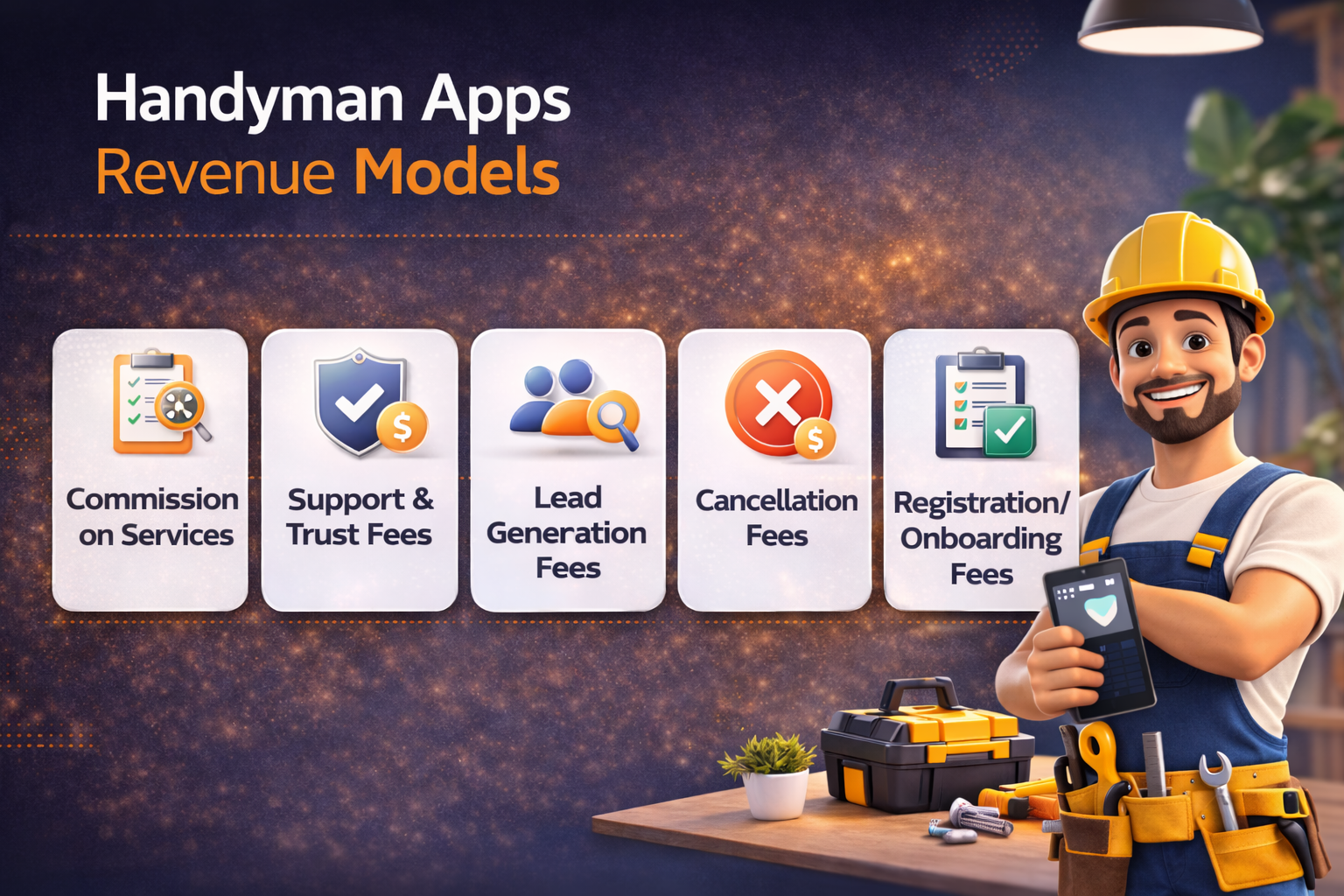
The main sources of revenue of handyman apps are commission-based fees (15-20 per job), service fees (7.5% trust/support fee), professional/user subscription fees, featured listing fees, and lead generation fees. A combination of these models, especially commission and subscriptions, will provide the most stable earnings.
The major revenue models of handyman apps are
Commission on Services (Most Common): The revenue model is to charge a percentage, like TaskRabbit charges a 15 percent commission or a varying service fee of 5-9 percent, of the amount spent on each booked service.
Support & Trust Fees: A small fee (e.g., $3.99) is charged on each transaction to maintain customer support, safety, and insurance.
Plans of Subscription (SAAS Model):
To Professionals: Handymen have the option to pay a monthly fee to gain access to better leads, reduced commissions, or premium features.
To the Customers: Customers are charged recurring credits to have priority booking, discounts or maintenance packages.
Lead Generation Fees: Experts pay a fixed amount of money to get the contacts of customers or to make quotes, irrespective of whether they have decided to do the job or not.
Advertising/Featured Listings: Handymen will have an opportunity to pay to be on top of the search results so that they are more visible.
Cancellation Fees: These are fees imposed on customers whenever they cancel at the last minute to cover the professional.
Registration/Onboarding Fees: A non-refundable fee that service providers pay to enter onto the platform, e.g., $25.
Revenue Maximization Strategies:
Dynamic Pricing: As in the case of TaskRabbit, service fees would be charged more during peak times.
Integrated Payment Systems: Payments through the app will guarantee the commission on each job.
Upselling: This implies providing extra, high-profit services as part of the app reservation channel.
7. Conclusion
In conclusion, on-demand handyman applications represent a new solution created because of the digital transformation of home services. Such platforms make it easy to book repair and maintenance services, thereby providing convenience, transparency, and reliability to the customers.
Simultaneously, they provide the service providers with new possibilities in order to develop their business and attract more people.
With the ever-changing technology and changing expectations of consumers towards instant solutions, on-demand handyman apps will eventually be the future of home repair services.
The current generation of businesses that adopt this trend will be in a good position to dominate the next generation of the home services business.
FAQs
1. What Are Services That I Could Book With A Handyman?
The handyman app provides plumbing solutions, electrical, furniture delivery, appliance delivery, carpentry, painting, and repairs.
2. How Fast Can An App Be Used To Book A Handyman?
The handyman applications provide plumbing solutions, electrical, furniture delivery, appliance delivery, carpentry, painting, and repairs.
3. Are Workers On Handyman Applications Checked?
Yes, the majority of applications in the handyman sector check professionals based on identity checks, background check, certifications, and customer feedback in order to have high-quality service delivery.
4. How Expensive Is It To Employ A Handyman On An App?
Prices are based on the type of service, the complexity of the job and the location, but the majority of apps display upfront costs or estimates prior to booking.
5. Is It Possible To Book Handyman Services At A Certain Time?
Yes, it is true that handyman apps permit their users to choose convenient time slots and thus they can book far in advance or instantly book emergency home repairs.