
Cart 0
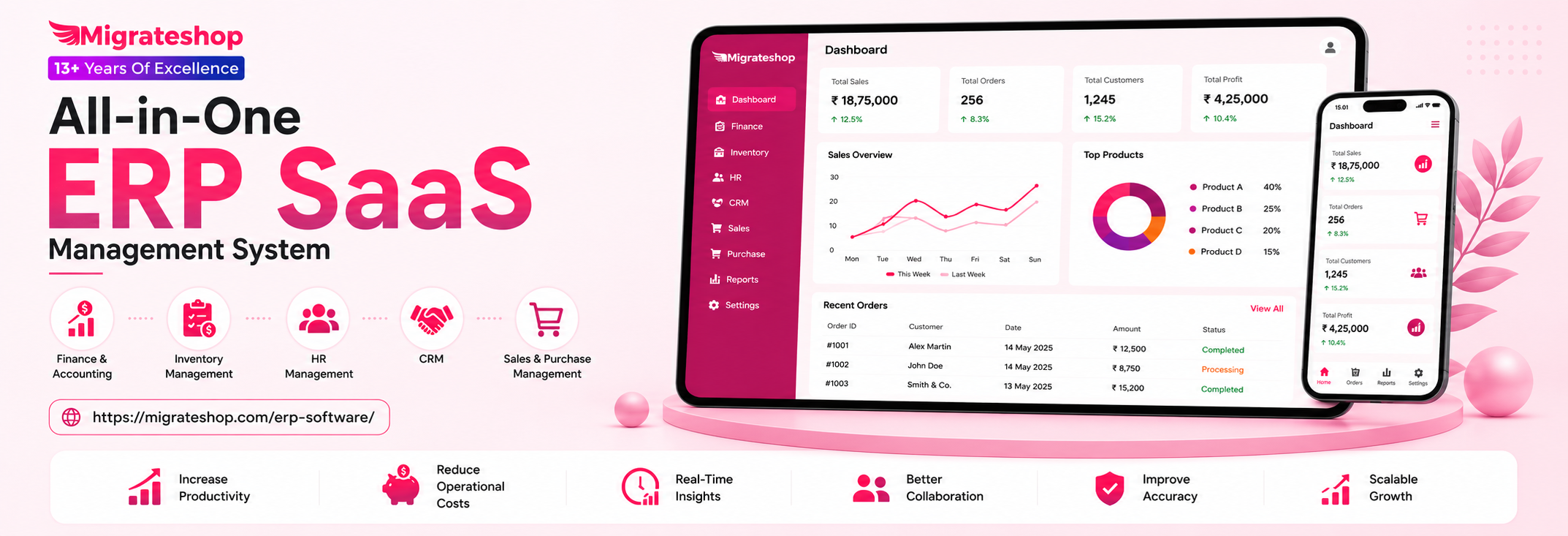
If you’ve ever spent an afternoon reconciling numbers between three different spreadsheets, you already know the problem ERP SaaS was built to solve. Business operations have gotten more complicated over the last decade — more sales channels, more locations, more people working remotely, more data flying around — and a lot of the tools businesses relied on a few years back simply weren’t designed for this.
That’s part of why so many growing companies are turning to cloud ERP software as their operational backbone. Rather than installing software on individual machines or paying for servers, a business can run finance, inventory, HR, and sales from one cloud-based platform, accessible from wherever people happen to be working. This guide covers what that actually means in practice, why it matters, and how to think about choosing a solution — including where Migrateshop ERP fits in.
Why Modern Businesses Are Moving Toward ERP SaaS
Back in the day, traditional business software usually demanded expensive servers, some dedicated IT group , and pretty long implementations. Lately, most businesses rather use ERP SaaS, since it runs in the cloud, goes live fast, stays simple to service, and you can reach it from anywhere. Compared to the old fashioned platforms, these systems also handle updates automatically..
With the rise of remote and hybrid work, Cloud ERP software helps people securely reach business data from practically any location.Meanwhile, modern Enterprise Resource Planning software automates a lot of the usual routine like invoicing, inventory updates, and reporting. That way organizations get a better handle on efficiency and productivity.
Common Business Challenges
Before switching to a unified system, most businesses run into a fairly predictable set of problems:
- Disconnected departments – Finance, sales, and inventory each working out of tools that don’t talk to one another.
- Manual processes – Someone re-typing the same data into two or three different systems.
- Inventory inaccuracies – Stock counts on paper that don’t match what’s actually sitting on the shelf.
- Limited visibility – Leadership making calls based on reports that are already a week old.
- Poor collaboration – Teams working in their own silos with no shared source of truth.
- Inefficient reporting – Hours lost every month just compiling numbers by hand.
This is precisely where an ERP SaaS Solution earns its place: by centralizing data across departments, it removes manual reconciliation and gives every team the same accurate, real-time picture of the business.
Ready to Simplify Your Operations?
Boost efficiency and simplify your business with Migrateshop ERP. Request a demo or contact our team to get started today.
Core Features Every ERP SaaS Solution Should Offer
1.Inventory Management
Realtime stock visibility across warehouse and store.Know exactly what’s in store and where without the need to ask anyone.
2.Finance & Accounting
Send invoices, manage expenses and track budgets from a single interface. Reduce the time spent manually matching data from multiple sources.
3.Human Resource Management
Handle payroll, employee attendance, records and much more from a central location. Automate everyday tasks so you spend less time in administration.
4.CRM
Create and share customer records, lead tracking and deal opportunities.All team members have the same access to information ensuring no leads slip through the cracks.
5.Sales & Purchase Management
Reduce duplicated data entry from order and purchase management through to payment processing and vendor coordination.
6.Reporting & Analytics
Dashboards and reports showing real time performance rather than historical data. Make more accurate and timely business decisions.
7.Workflow Automation
Reduce routine tasks. Our system can automate these processes to ensure they are completed efficiently and correctly.
8.Cloud and Mobile Access
Secure anywhere access from any desktop, tablet or smart device, helping to improve remote working and on-the-go access.
9.User Roles and Permissions.
Ensure that employees only see the information they need to, while protecting access to sensitive data.
10.Data Security and Backup.
Robust protection against hardware and software failures, data breaches and unauthorized access to your data.
Together, these features separate a genuine SaaS ERP platform from a collection of loosely connected tools wearing the same label.
Business Benefits of ERP SaaS
Consider a retail business managing three physical locations and an online store: without a connected system, checking inventory means calling each store individually. With a properly connected ERP Solution, one dashboard shows exactly what’s in stock everywhere, in real time.
Common benefits businesses experience include:
- Increased productivity – Less time on manual reconciliation, more time on actual work.
- Reduced operational costs – Fewer errors and less duplicated effort mean real savings.
- Real-time insights – Decisions based on current data, not last week’s export.
- Better collaboration – Shared data means fewer miscommunications between teams.
- Faster decision-making – Leadership can act on information as it happens.
- Automatic updates – No manual patches or costly upgrade projects.
Industries That Benefit the Most from ERP SaaS
While this category of software is often associated with manufacturing, its reach extends far beyond that.
- Manufacturing – Controlling raw material, production flow, and quality assurance.
- Retail – Balancing your physical and online inventory.
- Healthcare – Consolidating and accurately tracking patient, billing, and supply chain data.
- Logistics – Tracing shipments, coordinating the fleet and monitoring your warehouses.
- Wholesale distribution – Processing large orders and orchestrating supply chains.
- Education – Managing admissions, institutional budgets, and employees
- E-commerce – Synching your inventory across different selling channels on real time.
How to Choose the Right ERP SaaS Solution
Selecting a platform is a significant decision, and a structured evaluation prevents a costly mismatch. Consider these factors:
- Business size – Choose software that fits your team’s size and needs.
- Industry requirements – Select modules tailored to your industry.
- Scalability – Ensure the system can grow with your business.
- Customization – Pick software that adapts to your workflows.
- Integration – Connect easily with your existing tools.
- Data security – Look for strong security and data protection.
Why Businesses Choose Migrateshop ERP?
Among the many platforms available, Migrateshop ERP has built a reputation for making this decision easier. It’s designed around a simple idea: business management software should simplify operations, not add complexity.
Here’s what sets it apart:
- Cloud-based – Runs entirely online, with no servers to maintain.
- User-friendly – Teams get up to speed quickly, without a lengthy training process.
- Flexible modules – Turn on only what your business actually needs.
- Secure infrastructure – Strong access controls protecting your data.
- Affordable pricing – Priced for growing businesses, not just large enterprises.
- Scalable – Grows with new locations, staff, or workload as they come.
Businesses evaluating their options can explore ERP features and modules directly on the ERP Software page.
Future of ERP SaaS
This category of technology isn’t standing still. Several trends are shaping where it’s headed next:
- Artificial Intelligence: is stepping in to catch anomalies, forecast demand, and take the manual review work off people’s plates.
- Machine Learning: keeps recommendations and alerts sharper over time, learning from real sales and customer behavior instead of static rules.
- Mobile ERP: is making more of the platform usable right from a phone — not something you’re tied to a desktop for anymore.
- Business Intelligence : Helping leadership move away from instinct-driven decisions and toward choices backed by real data.
- Process Automation : quietly taking over routine workflows, cutting down on how much manual intervention they need.
These innovations point toward a future where an ERP Solution isn’t just a system of record, but an active participant in day-to-day decision-making.
Final Thoughts
Businesses usually don’t outgrow the good ideas, they outgrow the disconnected tools. As operations get more complex, and data starts traveling around in spreadsheets plus manual processes, it eventually becomes not sustainable, quickly. An ERP SaaS solution hits that from the source, because it brings finance, inventory, HR, sales, and reporting into one connected system, and it’s accessible from anywhere.
For businesses evaluating their next step, Migrateshop ERP offers a practical, scalable, and secure path forward — built to support long-term growth rather than short-term fixes.
Frequently Asked Questions
