
Cart 0

The rise in fuel prices, tighter customer expectations, the need to execute real-time tracking, and the way operations have become quite complex have forced companies to reevaluate the way they operate their fleets. To answer that, we are happy to present our recently developed Logistics Service App – an app that has been created to provide fast, reliable, and secure deliveries
It is an innovative application in fleet management that will give business owners strong tools to organize their operations and improve their efficiency, as well as be on the leading edge of the industry. And to make the process even easier, you will have a coupon code to cut exclusive costs on the first purchase, which is OFF20.
What Is a Logistics Delivery App?
A logistics delivery app is an online software that is used to streamline and control the whole supply chain, including warehouse-to-home delivery.
It integrates drivers, dispatchers, and customers in real time to automate operations such as route planning, GPS tracking, proof of delivery, and customer notifications to save on expenses and maximize efficiency.
Why Traditional Fleet Management No Longer Works
The old methods of fleet management using manual systems, spreadsheets, and reactive maintenance are no longer effective since they cannot meet the demands of the current complexities of operations, their high cost, and the necessity of instant data-driven decisions.
Stereotypical, piecemeal approaches result in too much downtime, wastefulness, and a lack of ability to fulfill sustainability or regulatory expectations.
This is why conventional fleet management is going wrong:
Reactive vs. Proactive Maintenance: Conventional processes are based on time-based and scheduled maintenance and not on predictive, real-time data, and, therefore, cause unplanned breakdowns.
Data Fragmentation and Manual Processes: The use of spreadsheets, whiteboards, and manual data entry creates inefficiencies and inaccuracies and lacks real-time visibility of operations.
Lack of ability to handle diverse fleets: The current fleets are more often composed of internal combustion engines, EVs, and hybrids, which demand complex and more specific data analysis, which is not available through regular systems.
Inefficiencies and Increasing Costs: The high fuel, maintenance, and insurance costs, together with the supply chain problems that have led to the delay in the new vehicle, make traditional purchases and traditional asset management too costly to sustain.
Compliance and Safety Risks: As more regulation is introduced, manual compliance tracking is highly prone to error, and this may result in safety issues and fines.
Difficulty in Adopting Technology: Being sluggish or adverse to adopting AI, IoT, and cloud-based analytics implies that companies are unable to optimize routes and fuel used in real-time.
To be successful, companies are transforming to control vehicles towards streamlining, AI-enhanced computerized fleets, and choreography.
Key Features of a Logistics Delivery App
The main advantages of a logistics delivery app are the real-time GPS tracking, the route optimization with artificial intelligence, and the digital Proof of Delivery (POD).
The key elements of the user interface, driver interface, and administrator interface are real-time notifications, automated dispatching, in-depth analytics, and in-app security.
Real-Time GPS Tracking & Visibility: Enables real-time monitoring of shipments and vehicles, and provides accurate ETAs.
Path Optimization: AI can be used to determine the least costly and quickest routes, resulting in the consumption of less fuel.
Proof of Delivery (POD): A digital signature, photo, and barcodes are provided to determine delivery.
Driver Mobile App: This will provide drivers with a list of tasks, directions, and order status.
Automated Dispatching: A computerized form of allocating orders to the nearest or the most suitable driver/vehicle.
Real-Time Notifications: Delivers SMS/push notifications to the customers regarding the status of delivery, lag, and tracking.
Analytics & Reporting: Provides reporting on the performance of the drivers and delivery time, as well as bottlenecks of operations.
Inventory/Warehouse: Inventory, dispatch, and in-app scanning.
In-App Communication: Provides two-way communication between drivers, dispatchers, and customers.
Business Benefits of Using a Logistics Delivery App
The efficiency of the logistics delivery apps is enhanced through AI-enhanced route optimization to reduce the travel time by slashing it to the bone, real-time GPS tracking to dispatch proactively, and automated features such as ePOD (electronic proof of delivery).
They minimize fuel use and idle time, improve driver communication, and improve customer satisfaction as a result of proper tracking.
Major Benefits of Logistics Apps in Fleet Efficiency
Route Optimization: Traffic, delivery window, and vehicle capacity are analyzed to produce the quickest routes, which save mileage and fuel consumption significantly.
Real-Time Tracking & Visibility: The dispatchers will be able to see the location of vehicles in real time, which also allows making changes to the traffic, road closures, or last-minute orders.
Automated Workflows and Proof of Delivery: Digital Proof of Delivery (ePOD) offers drivers the opportunity to record signatures, photographs, and time stamps, which lowers paperwork and conflict.
Monitoring of Behavior and Safety of Drivers: The applications monitor speed and traditional idle time to enhance the performance of drivers, safety, and cost reductions in operations.
Effective Communication and Scheduling: With centralized platforms, there will be less miscommunication and an increase in matching drivers to loads to reduce the number of empty miles and even out the workloads.
Maintenance Scheduling: Predictive maintenance capabilities monitor the usage of the vehicle to have it serviced in order to extend the life of the assets.
Combining those features, apps transform manual processes into data-driven automated operations that would boost productivity in general.
How to Choose the Right Logistics Delivery App?
Selecting an appropriate logistics delivery app means a balance between required functionality, such as the real-time tracking system, optimization of the route, and management of the drivers; the size of the business and its scalability; and cost.
Choose the solution that provides a friendly mobile application, strong proof-of-delivery (photo/signature), and transparent integration with the current systems to enhance the efficiency of work and customer satisfaction.
Important Factors in the Selection of a Logistics App
Key Features Functionality:
Real-time Visibility: Be able to have the app offer a dashboard to track vehicles, routes, and order status in real-time to proactively handle delays.
Route Optimization: Find the software that optimizes the routes based on the algorithms for finding the fastest and most efficient route, taking into account traffic and vehicle capacity.
Driver App/Proof of Delivery: Select an app that can run on a mobile device (iOS/Android) and is simple to use so that drivers can take photos, signatures, and notes to verify deliveries.
Customer Communication: The application must provide proactive, automatic, and correct customer updates like predictive ETAs in Outvio.
Business Fit & Scalability:
Size Constraints: Small businesses can focus on low-cost and simple tracking when larger and expanding companies require more advanced functionalities, such as multi-depot management and complex analytics.
Operational Needs: Make sure that the app supports such operational requirements as recurring routes, geocoding, and voice navigation by Route4Me.
Cost & Support:
Total Cost of Ownership (TCO): Go beyond subscription charges to training, implementation, and additional costs of additional vehicles or users.
Reliability vs. Cost: Do not just select based on the price; very cheap providers could be extremely unreliable and lack support, and this leads to customer dissatisfaction.
Implementation & Usability:
Driver Experience: The app should be intuitive to reduce training time and promote adoption.
Future Trends in Logistics Delivery Technology
The technological revolution in the future of logistics delivery is quickly moving to artificial intelligence through automation, autonomous vehicles, and sustainable systems to increase efficiency, lower costs, and speed.
The major trends are AI-optimized last-mile delivery, drone delivery, micro-fulfillment centers, and blockchain to provide transparency and fulfill the increased e-commerce demand without negatively affecting the environment.
Self-driving and Drones: AVs and drones are not only moving on to the pilot project stage but also deploying to lower the last-mile expenses and enhance service in cities and rural areas.
Smart Optimization and Analytics: AI and machine learning are applied to prevent wastage of time by using AI in predictive analytics, demand forecasting, and real-time route optimization.
Micro-Fulfillment Centers: Smaller, automated urban warehouses that are located nearer to the customers are being implemented in order to drastically cut delivery times and the last-mile costs.
IoT & Real-Time Tracking: IoT (Internet of Things) devices facilitate end-to-end visibility, which provides real-time and granular information concerning the location and condition of shipments.
Transparency with Blockchain: Blockchain is a technology employed to ensure the security of transactions, minimize paperwork, and enhance traceability in supply chains.
Green Logistics: Electric vehicles and so-called smart energy management systems are gaining momentum as must-haves to make the logistics processes less carbon-intensive.
Robotic Automation (AMRs): The warehouse’s Autonomous Mobile Robots (AMRs) are increasing the speed of picking, sorting, and loading.
The purposes of these technologies include handling the labor shortage, escalating transportation expenses, and also enhancing the safety and customer needs of safe and fast delivery.
Conclusion
In conclusion, the logistics business is changing fast, and technology is essential in making the businesses remain competitive. Our Logistics Service App is expected to keep you at the top of the curve by making your fleet management better, more efficient in delivery, and secure in its operations. You can save additional money on your initial purchase, which is an even greater advantage to use this innovative solution.
With the rise in the delivery needs and the complexity of the operations, it is no longer a matter of choice that investment in correct fleet management technology is needed, but rather a necessity.
FAQs
1. What is a Logistics Delivery App?
A logistics delivery app is a type of software that allows businesses to coordinate fleet activities, route optimization, and real-time vehicle tracking, as well as automate the workflow of their delivery activities.
2. What is the Cost-Reduction in Fleet Management Software?
It lowers the fuel usage, minimizes human mistakes, increases the use of the vehicle, and maximizes the efficiency of the deliveries, which will result in huge savings.
3. Would a Logistics Delivery Application Fit well into Small Companies?
Yes. A lot of scalable solutions have flexible pricing, and thus can be available to small and medium-sized businesses.
4. How Much Time for Implementation?
The implementation is dependent on the complexity of operations but normally takes between a few weeks and a few months.

You may also like
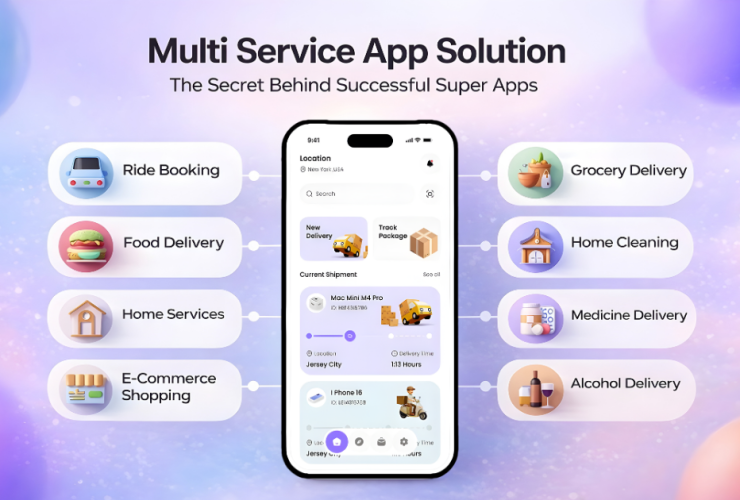
Multi-Service App Solution: The Secret Behind Successful Super Apps
Multi-Service App Solution: The Secret Behind Successful Super Apps
In the modern digitalized and busy world, people demand convenience, speed, and efficiency of the...

eBay Auction Script: Things You Need to Know for Scaling Your Business
eBay Auction Script: Things You Need to Know for Scaling Your Business
It is not always easy to scale an eBay business. It takes time, effort, and...

What Makes a Powerful LMS Script for eLearning Startups in 2025?
What Makes a Powerful LMS Script for eLearning Startups in 2025?
Online learning platforms. The online learning platforms evolved from primitive mainframe computer systems and correspondence...