


Cart 0

In the contemporary digital economy, online marketplaces are thriving. As a result, buying and selling platforms that connect the two parties directly are now among the most successful business models on the internet. In particular, one of the major components of this ecosystem is Classified Ads Software, where people and companies can post ads, market services, and sell products easily.
For example, popular websites like Quikr have shown the strength that the classified model can have by matching millions of buyers and sellers in several categories, including real estate, jobs, vehicles, and electronics.
Consequently, for start-ups and entrepreneurs, an interesting opportunity is the launch of a classified ads platform. Nonetheless, developing such a system is time- and resource-consuming in terms of technical skills and investment. Therefore, classified ads software can be featured.
1. What Does Classified Ads Software Mean?
Classified ads software is a web application to build, operate, and profit from online marketplaces to sell, purchase, or hire goods and services. In essence, it provides a turnkey development of a site such as Craigslist with easy-to-use listing forms, search, filters, secure online credit card payments, and mobile interfaces, commonly referred to as classifieds, real estate, or career opportunities.
The Main Characteristics of Classified Ads Software,
Listing Management: This enables users to create, modify, and update ads, and administrators to view or accept listings.
Elaborate search and filtering: This feature lets customers search by category, location, price, or any custom field.
Monetization Alternatives: Abilities to pay to be listed, premier spots, subscription plans, or even to get commissions on sales.
Combined Payments and Security: Secured online payment gateway, authentication of users, and, in some cases, automated detection of fraud.
Map Integration: The ability to integrate with Google Maps or OpenStreetMap to show the locations of sellers.
Responsive Design & Mobile Apps: Provides the site to be mobile-friendly in order to reach as many users as possible.
Classified Ads Software types,
Web-Based: Websites designed for niche, local, or general classified advertisements.
WordPress Plugins: The extensions that introduce the ability of classification to a normal WordPress site.
Print Plus Digital Solutions: Solutions that accommodate both online advertisements and print-ready exports to newspapers or magazines.
2. Classified Ads Software: How Does It Work?
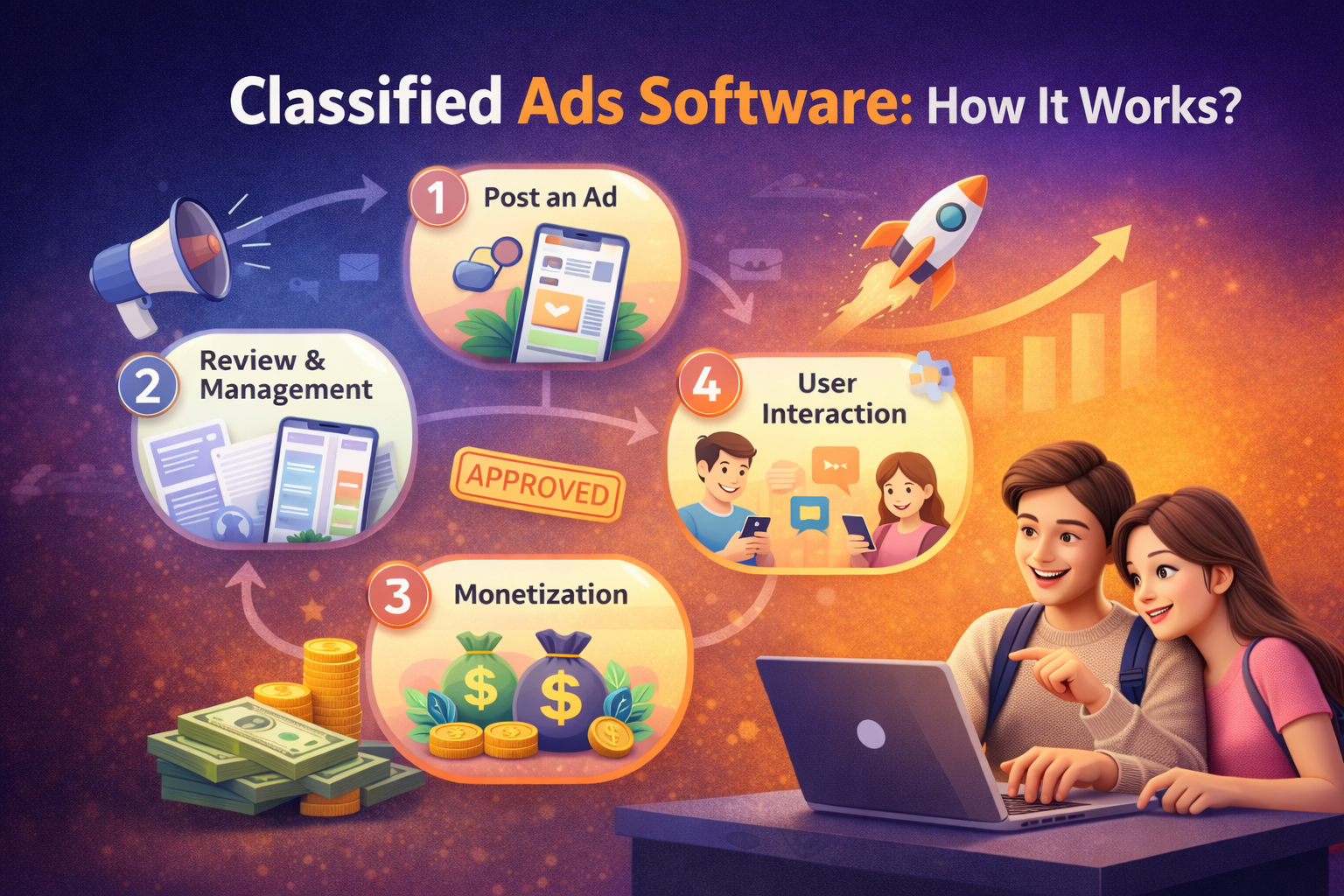
The classified ads software operates under the principle that it offers a database-based, platform-structured system where users are allowed to post, manage, and search listings (goods, services, jobs) based on their location or type.
In essence, it operates with a user-facing interface and an administration panel where the management is based, and it processes user registration, uploading images, search options, and monetization features such as featured ads, which are paid.
The Classified Ads Software has the following key components:
Database Management: This is the heart of the software, where all details, user data, and attributes (e.g., car make, model, and price) are stored using tables to organize the data effectively.
User Interface (Front-end): Furthermore, it has search bars, category browsing, location-based filtering, and user-interactive features to allow users to post listings or contact sellers.
Admin Panel (Back-end): This provides the owner with control to moderate content, user accounts, configure pricing packages, and analytics.
Listing Submission and Moderation: Initially, the user is asked to complete special forms, to post photos, and to choose a category. Subsequently, listings can be approved, edited, or deleted.
Search and Filters: So far, the strong search engines enable one to filter the search results by keywords, location (radius search), category, price, or type of product.
3. Essential Features of Classified Ads Software
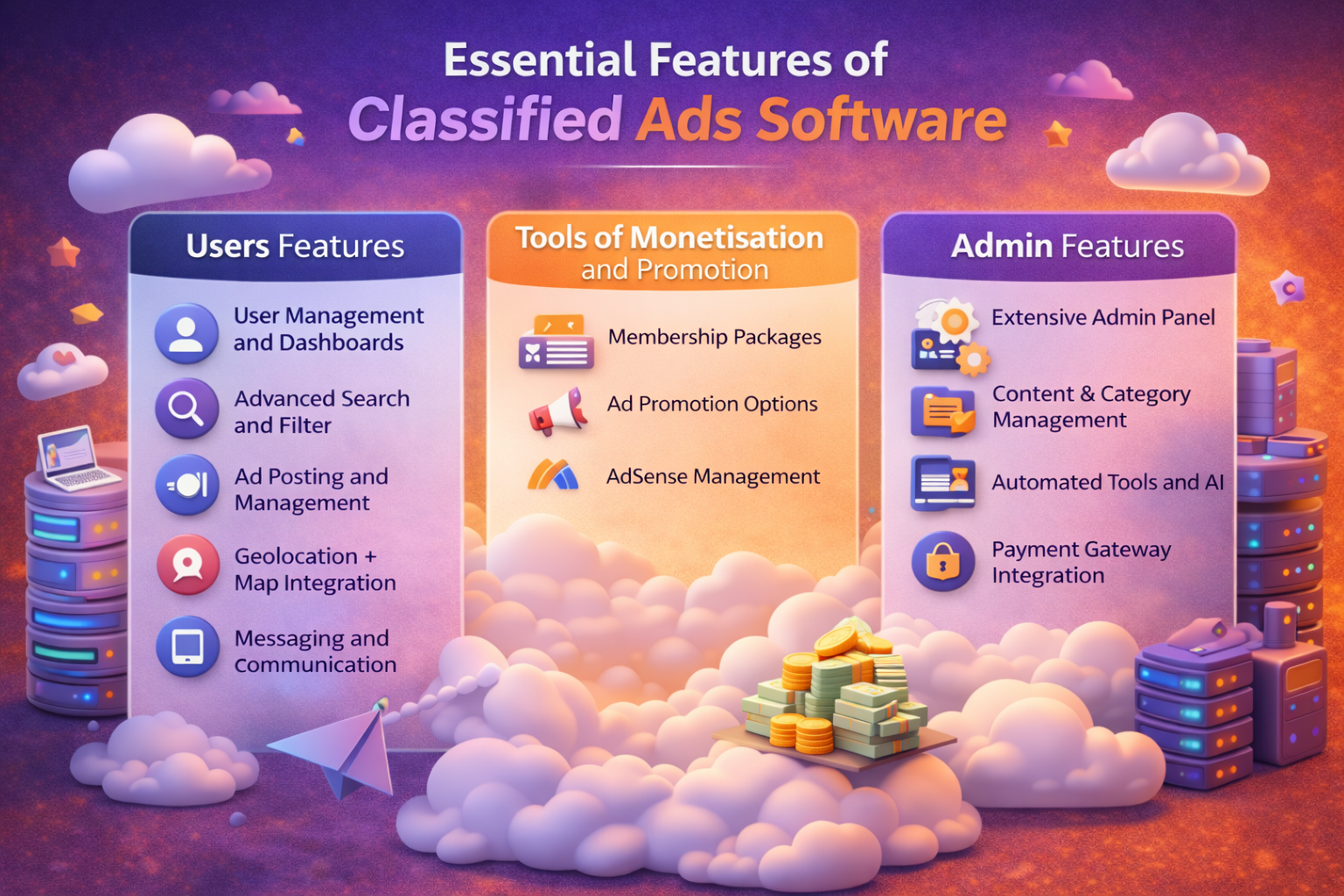
Classified Ads Script is a turnkey or full-service software to develop, administer, and profit from (monetize) online listing platforms. Those are,
Core Functional Features
User Management and Dashboards: Allows users to create, edit, delete, and renew their listings and also have personal dashboards to track the performance and messages of their advertisements.
Advanced Search and Filter: It gives the user an option to filter the listings by category, location, price, radius, subfields, and keywords.
Ad Posting and Management: Rich text description, image gallery, and attachments. Basic and formatted advertisements.
Geolocation + Map Integration: Includes Google Maps or OpenStreetMap to show the distance between items/sellers, a feature that local businesses require.
Messaging and Communication: There are built-in chat or contact forms that facilitate communication between buyers and sellers.
Tools of Monetisation and Promotion
Membership Packages/Paid Listing: The option of providing flexibility to charge for the posting of ads or provision of subscription-based packages.
Ad Promotion Options: The opportunity to promote the ads to increase their visibility by pushing them to the first page of the search results or highlighting them.
AdSense and Banner Management: It allows the display of third-party network ads (such as Google AdSense) or the sale of banner space.
Administration/Backend Features
Extensive Admin Panel: User and listing management and approval, deletion, and editing tools.
Content & Category Management: Capacity to build infinite categories, subcategories, and custom listing fields to customize the platform to a specific niche.
Automated Tools and AI: AI that reminds users to repurchase advertisements and controls automated advertisement sales.
Payment Gateway Integration: Multiple payment gateways (Stripe, PayPal, and credit cards) will be monetized.
4. Advantages of Classified Ads Software to Startups
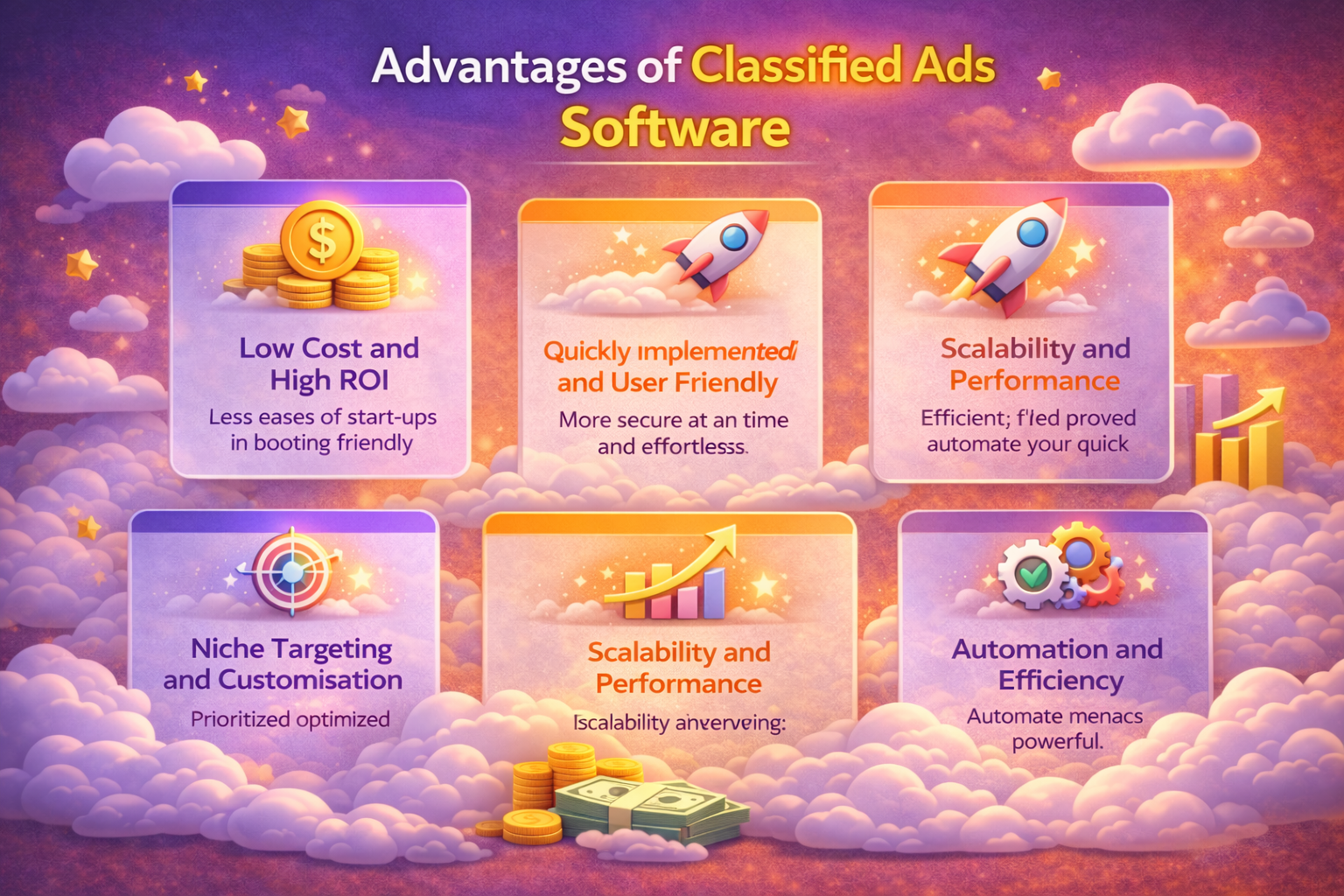
The classified ads app provides startups with an inexpensive, fast deployment platform to create web-based marketplaces, with revenue being made by way of listing fees, premium placement, and advertising.
Moreover, it can provide niche targeting, brand visibility, and an easy and automated management tool that enables non-technical founders to effectively control the user traffic and scale operations.
Key Benefits for Startups:
Low Cost and High ROI: Classified platforms have a low-cost entry point, and many of them are free or very cheap to establish. In many cases, monetization of the startup may be seller fees (e.g., 15-5% of sales) or advertisements.
Quickly Implemented and User Friendly: There are numerous platforms with ready-to-use scripts enabling businesses to be launched within no time with minimal development efforts.
Furthermore, the backend is normally friendly and allows easy administration of the categories, user management, and ad moderation.
Niche Targeting and Customization: By engaging in custom fields and specific target categories, startups are able to exist and flourish by addressing specific segments of the localized market or certain niche markets directly to audiences that are interested.
Scalability and Performance: Classified software today can scale to millions of listings and can be integrated with cloud storage (e.g., Amazon S3) to improve performance and speed.
Automation and Efficiency: Automated systems can keep listings current, and therefore, fewer man-hours are required to maintain the listings.
These tools allow small businesses to concentrate on growth and strategy and not on technical infrastructure.
5. Classified Ads Revenue Models
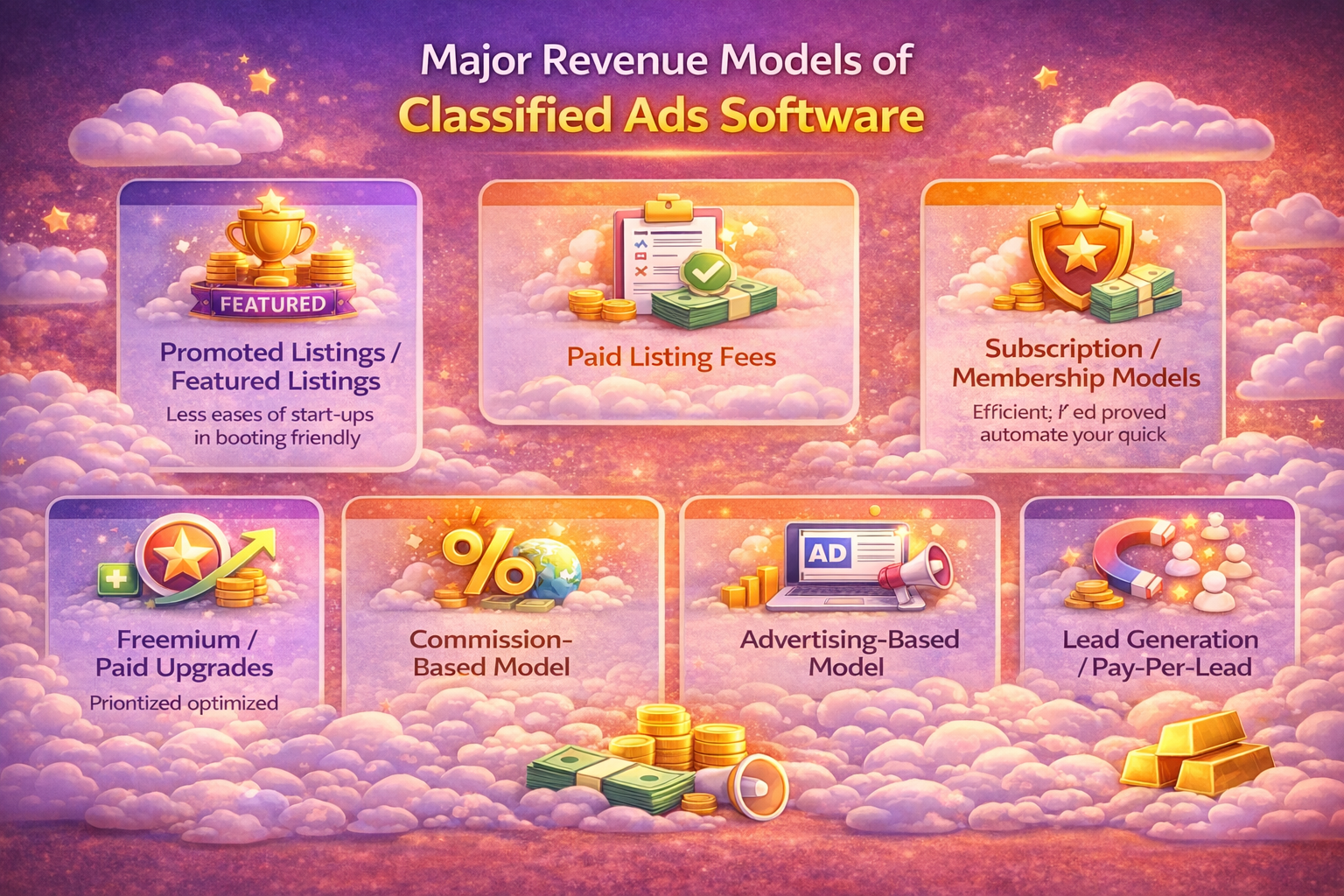
Classified ads platforms rely on revenue models based mainly on featured/promoted listings, subscription memberships, pay-per-post fees, and display advertising (e.g., Google AdSense).
Additional typical solutions comprise transaction commission charges on in-platform sales, lead generation prices, and premium upgrades to boost vendor exposure, including top-of-search positioning.
Classified Model Major Revenue Models
Promoted Listings / Featured Listings: A user can pay to use their advertisement to be prominent (e.g., featured, on top of search results, first location on the homepage).
Paid Listing Fees: A one-time fee to list an ad, sometimes applied to help manage spam as well as enhance listing quality.
Subscription/Membership Models: The sellers get recurring monthly or annual fees, normally with some number of free or negotiated listings.
Freemium/Paid Upgrades: Basic listings are free; however, users can contribute to premium features like adding additional photos, video links, or prolonged ad times.
Commission-Based Model: The platform charges a percentage or a set sum based on the amount of the final transaction in case of a sale made on the platform.
Advertising-Based Model: Third-party advertisements (banners, PPC) on sites such as Google Adsense. This works best in high-traffic sites.
Lead Generation / Pay-Per-Lead: Billing service providers to access contact information of users who are interested in their services.
Strategic Considerations
Volume vs. Quality: While free listings will give high volume, paid listings will increase the quality of the listing, but at the expense of growth.
Niche Platforms: Niche sites (e.g., cars or real estate only) have the ability to charge more because of a targeted audience.
Hybrid Approach: In practice, the vast majority of successful platforms should include a combination of multiple approaches, including providing free postings with some paid options to promote or to pump the ad to the top.
6. Classified Ads Platform Future Trends
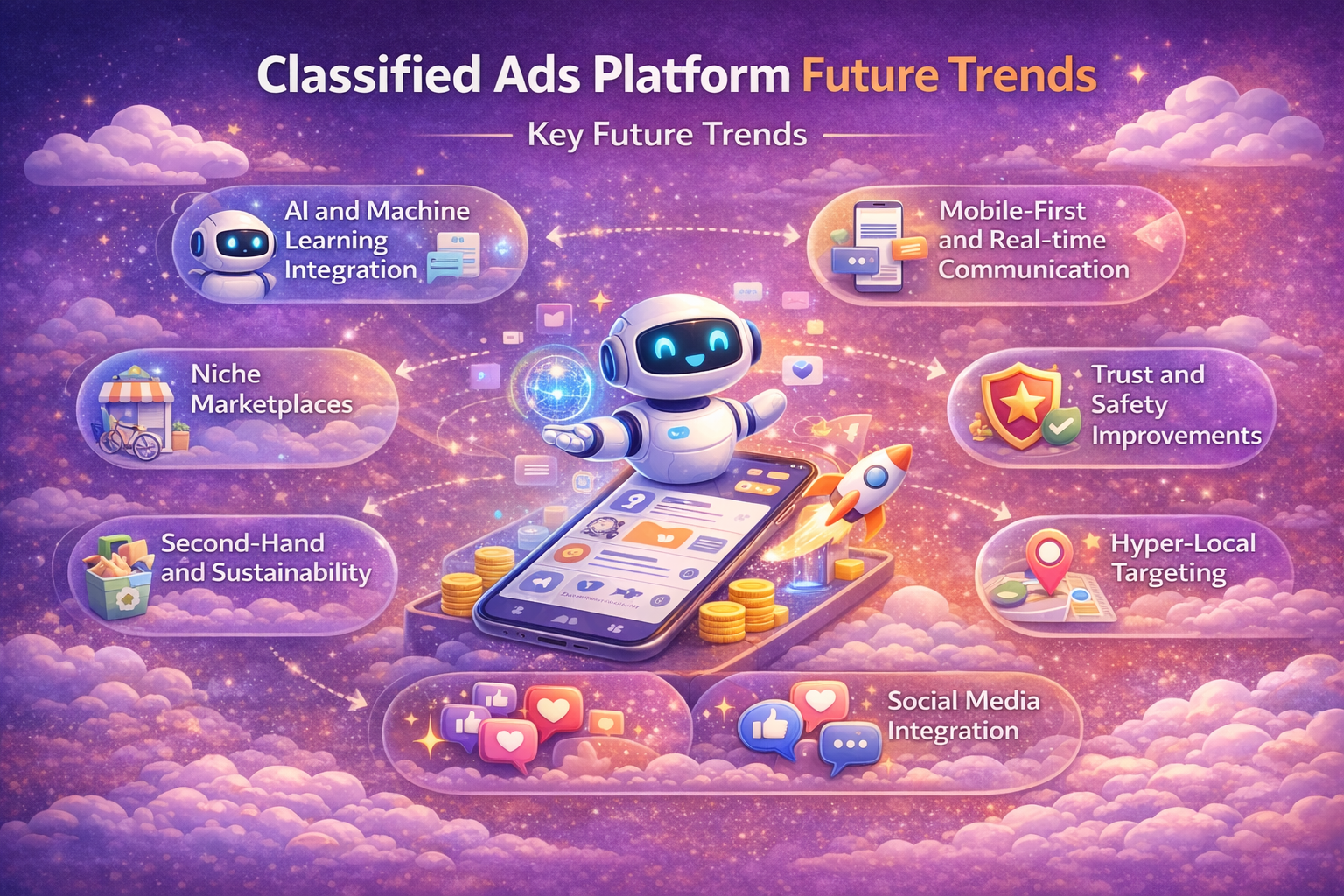
Looking ahead, the trends in the future of classified ads platforms include AI-assisted personalization, increased security against fraud, and mobile-first and user-centered experiences.
Moreover, social, video, and geolocation technologies are being combined with platforms becoming more specialized and niche-vertical (autos, real estate) to increase engagement. At the same time, there is a great focus on sustainability and secondhand markets.
Key Future Trends:
AI and Machine Learning Integration: In particular, artificial intelligence is applied to improve search, auto-generation of adverts, intelligent pricing, and improved detection of fraud.
Niche Marketplaces: Furthermore, vertical platforms that deal with particular industries, such as real estate, automobiles, or jobs, are on the rise, and they provide better quality, customized experiences.
Mobile-First and Real-Time Communication: Mobile-optimized experiences, instant messaging, and in-app messages are becoming the new norm, with more than three-quarters of users being on platforms on their smartphones.
Trust and Safety Improvements: More emphasis on privacy of the data, safe transactional service, and AI-based monitoring to prevent fraudulent listings.
Second-Hand and Sustainability: Because younger and eco-conscious customers are demanding eco-friendly second-hand items, more products are being listed second-hand.
Hyper-Local Targeting: Geolocation technology facilitates highly relevant local advertisements, which are vital to the user as well as the small, local business.
Social Media Integration: The definition of traditional classifieds is broadening to include the use of social media, which is rapidly being utilized to share and trade.
Monetization Shift: The focus on free models before switching to freemiums and subscriptions with higher quality and featured listing.
7. Conclusion
In conclusion, the sites of classified ads have now become an indispensable component of the digital marketplace economy. Overall, they offer an easy and yet effective means for individuals and businesses to buy, sell, and advertise products or services online.
In the case of startups and entrepreneurs, classified ads software is cost-effective and scalable to start a marketplace without the need for a full development investment. Moreover, these platforms have built-in functionality such as posting adverts, messaging, integration of payments, and enhanced search facilities, making them everything required to create an effective online market platform.
Therefore, startups can develop lucrative platforms that would match buyers and sellers effectively by selecting the appropriate classified software, as well as caring about the user experience.
Ultimately, with the digital marketplace rising every minute, the need to invest in classified ads software may be one of the best ideas that has come to mind for an entrepreneur who seeks to venture into the online business world.