
Cart 0
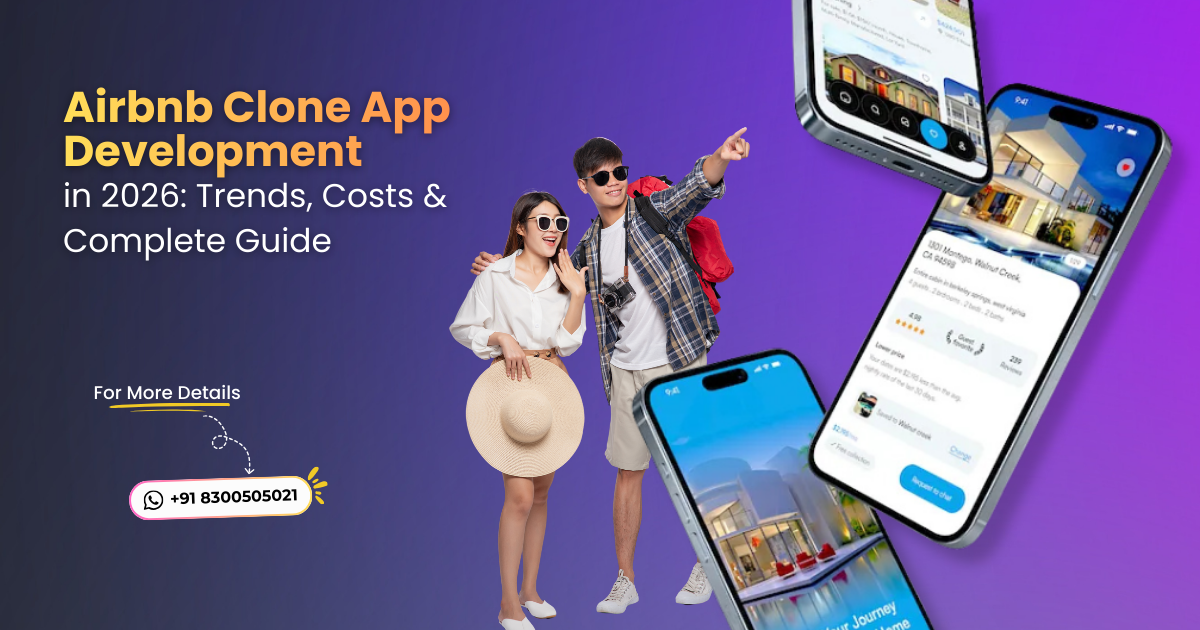
The emergence of digital-first travelling, alternative classes of accommodation, and peer-to-peer accommodation platforms has significantly altered the manner in which individuals make reservations worldwide. With the dawn of 2026, the trend of entrepreneurs and startups using Airbnb clone app development is becoming a quick, inexpensive, and simple method to start their own business in a rental marketplace.
Regardless of whether you are looking to create a platform in vacation rentals, homestays, niche stays, or luxury villas, by using a tailor-made Airbnb clone script, you can fast-track your entry into the market with minimum risk. Moreover, the trends, costs, features, tech stack, and the entire development process that you must know in 2026 are all discussed in this guide.
What is an Airbnb Clone App?
The Airbnb clone app is a customizable software platform, an application that is ready to use and functions as a copy of the original Airbnb platform, and allows entrepreneurs to start a vacation rental or property marketplace without necessarily developing its functionality.
It matches property owners (hosts) and travelers (guests) in short-term stays, having property posts, search/filtering, booking, secure payments, reviews, and user-friendly interfaces between the host, the guests, and the administrators.
Key Components & Features:
Host Panel: To list the spaces, be able to set prices, manage availability, accept/reject bookings, and communicate with guests.
Guest Panel: To enable travelers to search, filter, book, pay, and review properties, as well as message hosts.
Admin Panel: A dashboard in the center of which the business owner will control the users, properties, bookings, payments, and the settings on the platform.
Basic Essentials: Contains user authentication, property listing in photos/descriptions, booking engines, secure payment gateways (such as Stripe), reviews/ratings, and messaging.
Customization: In addition, it provides white-labeling, branding, and modification of features to meet business requirements.
What is Airbnb Clone App Development?
The Airbnb clone app development is to develop an off-the-shelf, highly scalable software platform with the exact core functionality (listing, booking, payments, and messaging) of the short-term rental markets. In other words, allowing entrepreneurs to launch their own property rental business in a short period of time without having to build it themselves, therefore saving time and cost by leveraging the ready-made architecture and functionalities.
Core Components & Features
Guest App/Web: Search and filters, browsing of property, booking, in-service messaging, wishlists, reviews, and payments.
Listing Function: Listing management, booking calendar, communication, payouts, Host App/Web.
Admin Panel: platform management and user/listing management, analytics, and payment management.
Technology: It tends to use white-label solutions, which are not only scalable, secure, and mobile-responsive.
Why Use a Clone Script?
Speed to Market: Get on the market with proven features.
Economical: Moreover, it is much cheaper to construct than to construct one.
Customization: Customize branding, features, and business models.
Market Entry: An existing model of entering the vacation rental market that is booming.
How does it work?
It is an online platform that links property owners (hosts) and travelers (guests) to temporary residences and resembles the simplicity of Airbnb in terms of user interface and a verified system of finding, booking, and managing accommodation.
Key Takeaway
An Airbnb clone will give you a shortcut to developing a competitive rental business. By utilizing these ready-made tools and a recognized format to build your own brand in a short period, you can enter the online accommodation market.
The Reason Why Airbnb Clone App Development Is Booming in 2026?
The current trend in Airbnb clone app development is booming because of the proven and lucrative sharing economy model; fast launch through pre-written scripts; low cost; and customization to niche markets, all of which are enhanced with the great capabilities of AI features (such as real-time messaging/pricing) and scalability to exploit the ever-increasing travel demand, which will generate instant ROI for entrepreneurs.
Key Aspects for the Boom:
Proven & Profitable Business Model: By riding on the success of Airbnb, you can use an established business model of short-term rentals that captures a huge and rapidly growing market of both visitors and property owners.
Reduced Time-to-Market: Ready-to-use clone scripts severely reduced the time spent on development, down to weeks, and enabled the development to be launched and revenue generated promptly.
Reduced Costs: Not Massive Development Teams and Costs Clones are very cheap, allowing you to spend more on marketing and scaling.
Niche Focus & Customization: Clones may be customized to certain markets (e.g. pet-friendly, eco-stays) or some special features, which will create a difference.
AI Implementation: AI will increase the customer experience by providing intelligent messaging, auto-suggestions, and dynamic pricing with powerful tools that hosts will be ready to pay for (SaaS model).
Scalability: Modern clones are constructed around scalable technology (cloud-ready, modular) to support the scaling from a small number of listings to thousands.
Data-Driven Insights: Intrinsic analytics will allow you to know what users are doing and what is going on in the market, which is one of the keys to competitive advantage.
Core Features of Airbnb Clone App
For an Airbnb clone app, key features span three core areas:
Guest Panel (easy sign-up, search/filters, wishlists, booking, chat, payments),
Host Panel (listing management, availability/pricing, financial reports, and host dashboard) and an Admin Panel (user/listing management, analytics, and payment control), all supported by secure payment gateways, map integration, and robust review/rating systems for trust.
Guest/Traveler Features
Registration/Profiles: Social/email login, profiles.
Advanced Search & Filters: Advanced filters such as price, type, location, amenities, and map integration.
Wishlists: Favorite property listings.
Booking System: Simple booking, reservation system, and calendar.
In-App Chat: Chat with the hosts prior to/during booking.
Payments: Accept various payment methods, including cards, electronic wallets.
Notifications: Booking, discount, and update notifications.
Reviews and Ratings: Enabling guests to drop and read comments.
Host/Property Owner Characteristics
Property Listing: Photos, descriptions, and pricing are readily uploaded.
Visiting the Management: Revise availability, pricing, and details.
Booking Calendar: Booking and availability.
Financial Reports: Monitor the earnings, payouts, and bookings.
Host Dashboard: Performance and Overview of the listings.
Admin Panel Features
User Management: View, manage, or ban users.
Listing Management: Adding/Editing the Listings.
Payment Control: Commission and payment management.
Analytics: Track the significant indicators such as users, bookings, and revenue.
Core & Technical Features
Payment Gateway: Stripe and PayPal integration (secure).
Map Integration: Google Maps API for location services.
Live Chat: Either Socket.io or Twilio to chat.
Security: authentication of the ID, secure transactions.
Multi-Language/Currency: Provision for international users.
Market Trends Driving Airbnb Clone App Development in 2026
In 2026, Airbnb clone app development is driven by strong market demand for unique stays, AI integration for smart listings & pricing, a focus on direct bookings via email lists, expansion into lifestyle services (cars, experiences), and the need for robust, scalable tech for seamless, personalized experiences, moving beyond basic listings to comprehensive property management platforms. Key trends include AI-powered assistants for hosts/guests, subscription models for premium features, virtual tours, and enhanced user experiences for higher conversions.
Key Market Trends Driving Development:
AI Integration: AI for automated guest messaging, dynamic pricing, smart property suggestions, and AI-driven search to enhance user & host experience.
Direct Booking Focus: Strategies to build customer email lists (e.g., via Wi-Fi sign-ups) for direct bookings to reduce reliance on OTAs, crucial for 2026.
Expansion into Lifestyle: Moving beyond lodging to include car sharing, local experiences, and trips, making the platform a daily-use app.
Enhanced User Experience (UX): Seamless booking funnels, mobile optimization, intuitive dashboards, and virtual/AR tours for better engagement.
Subscription Models: Offering “Pro” tiers with AI tools, advanced analytics, and marketing features as recurring revenue streams (SaaS).
Strong Market Demand: Continued traveler preference for unique, authentic, and affordable accommodations over traditional hotels.
Real-Time & Scalable Tech: Need for robust, scalable platforms with real-time availability and integrated payment solutions.
Why Invest in 2026?
Faster ROI: Modern clone scripts offer quicker market entry with pre-built features.
Niche Dominance: Opportunity to capture specific markets (e.g., pet-friendly, eco-stays).
New Revenue Streams: Beyond commissions, platforms can earn from premium features, ancillary services (tours, transfers), and subscriptions.
By incorporating AI, focusing on direct customer relationships, and expanding service offerings, Airbnb clones can thrive by meeting traveler demand for personalized, efficient, and holistic travel experiences.
Step-by-Step Process of Airbnb Clone Development
The clone of Airbnb would be developed based on planning, research, defining the key functionality (listings, booking, payments, messaging), a well-designed, great user interface/experience, construction of the front-end and the back-end, secure payment gateway integration, intensive testing, and, finally, launching and marketing.
It would be developed and marketed with the ready-to-go available scripts or no-code development based on its speed and host/guest experience, and scalability.
Phase 1: Planning & Discovery
Market Research and Goals: Determine your niche (e.g., eco-stays, luxury villas), target audience, and a discriminated value proposition.
Characteristics List: Overview, User accounts (host/guest), Property listings (photos, description), Search/filters, Booking system, Real-time messaging, Reviews, Payments, Admin panel.
Tech Stack/Platform: It will be able to choose between either custom code (React, Node.js, etc.) or no-code (Bubble) or clone scripts to develop it within a shorter time.
Phase 2: Design & Prototyping
Wireframing Sketch user flows: Has been sketching user flows and making them look attractive and have a user-friendly interface (UI) and experience (UX).
Interactive Prototype: Also, prototype an interactive prototype before coding the design.
Phase 3: Development
Database: Develop and create the database (SQL, MongoDB) of users, properties, bookings, etc.
Backend Development: Fourthly, Implementation and server-side Implementation, APIs, user authentication, and third-party services, such as maps and payments.
Frontend Development: Design the front-end of the web and mobile applications of applications in the chosen languages/frameworks (HTML, CSS, JS, React Native, Flutter).
The main essential components that are to be initiated are
User Authentication: Authenticate registration/log in (Social login as well).
Features: Hosts can add/manage properties, and guests can browse.
Booking Engine: Calendar system, on-the-spot booking/request, and availability check.
Payments: Add Stripe, PayPal, and similar services to make payments safely.
Messaging: Instant communication between the hosts and the guests.
Ratings: Rating and feedback.
Phase 4: Testing & Launch
Testing (QA): perform functionality testing, usability testing, performance testing, and security testing.
Deployment: Install the application and databases, and install the servers.
Launch: Distribute in application stores/on the web, set up the server, and do original work.
Phase 5: Post-Launch & Growth
Marketing: Online marketing, such as SEO and social media marketing, is targeted at attracting users.
Monitoring and Maintenance: Testing the performance, debugging the performance, and adding new features as per the user feedback.
Scalability: Auto-scale infrastructure.
Why an Airbnb Clone App? Why does Migrateshop have to develop it?
Migrateshop is an Airbnb clone script written in a feature-based and, moreover, highly customizable way, and is aimed at assisting a startup in launching fast.
- 100% customizable script
- iOS + Android App + Web
- Scalable, secure architecture.
- Affordable pricing
- Lifetime support option
Migrateshop would be the right place to be should you be proposing to open your rental marketplace in the near future.
Conclusion
In conclusion, the Airbnb clone app has tremendous potential to expand, and it is time to invest in developing the app. Having the most sought-after features and technology, as well as the monetization model, you can develop a successful, profitable rental marketplace that will compete with prominent players in the industry.
Migrateshop would not only save you time and money in the development itself but also the risks of creating a clone of Airbnb based on the already developed clone script and release your platform in a few weeks, not months.