
Cart 0
The vacation rental industry has been booming for some time now because travelers are searching for flexible, convenient, and personalized places to stay. Airbnb has shown that a digital platform connecting travelers and property owners can be profitable through property rentals, service fees, sponsored listings, and more. If you want to build an Airbnb like app, then you should know that this business is becoming popular for a reason. A good rental marketplace does more than just help people find and book a property. It generates revenue for property owners and managers, guests, and the rental app.
In this article, we’ll look at how a clone of Airbnb works, what the leading revenue-generating sources are, and how to build a profitable vacation rental platform.
What Is an Airbnb-Like App Business Model?
Let’s understand the Airbnb-like app business model. Airbnb app creation is a marketplace model that facilitates the rental property rentals, and it serves both: it helps users who are looking forward to rent out an apartment, house, or room in a property, as well as:
Hosts or property owners
Guests and temporary residents
For the marketplace itself, it acts as an intermediary between two types of users and generates income either through transaction fees or by conducting extra operations. 7 key participants in a rental marketplace:
Guests, or hotel guests
Short-term rental property owners – or hosts who rent in the short-term (e.g., by the night)
Marketplace owner, or platform operator.
applications for both Android and iOS devices, making it possible for people to book their accommodations anywhere, anytime
How Do Airbnb-Like Apps Make Money?
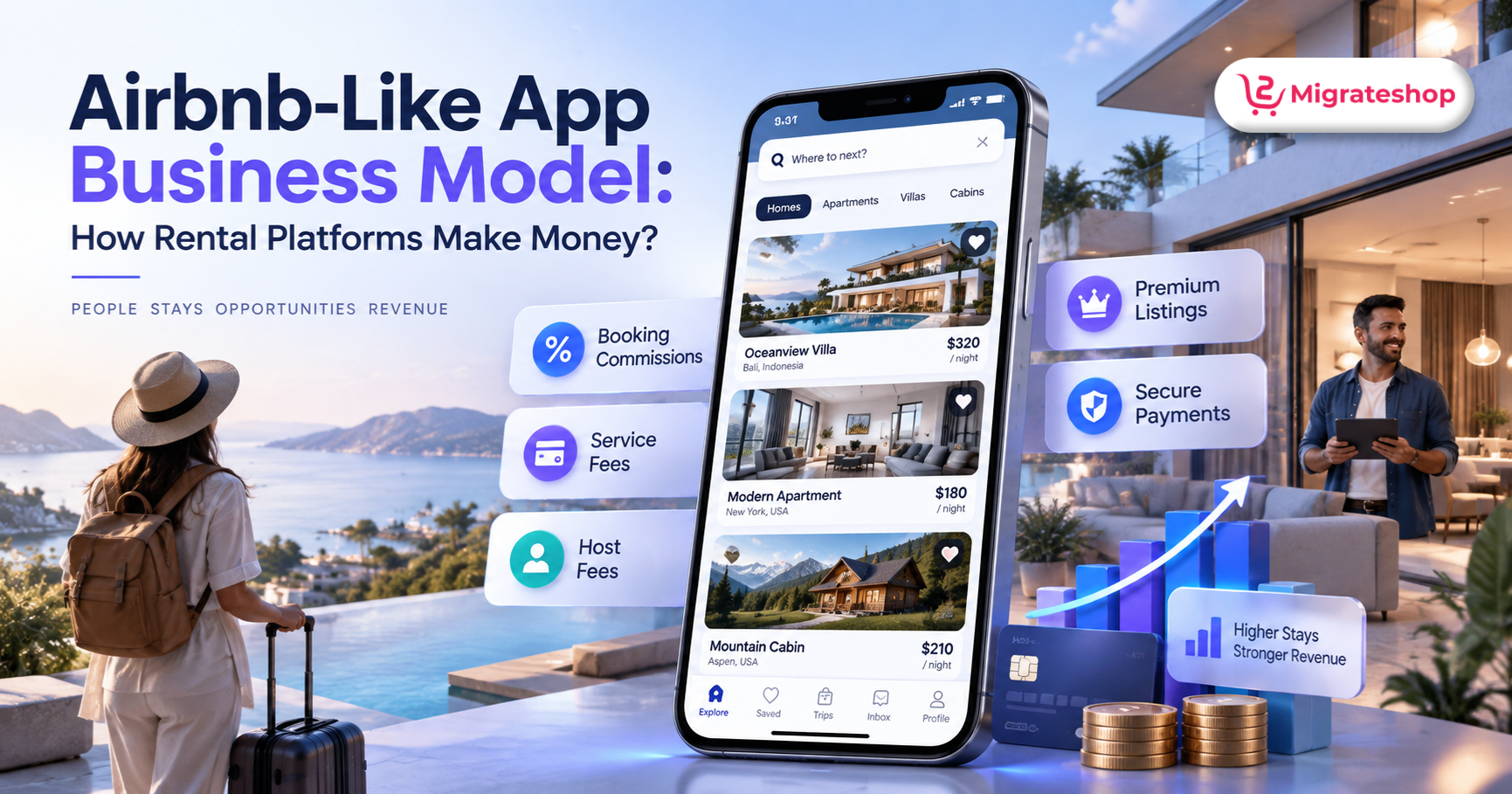
A vacation rental marketplace can monetize using a handful of revenue streams rather than just a single method. The specific combination depends on the target industry, feature tiers, property types, and the overall business model.
Booking Commission
This is often the most popular and best monetization models for rental marketplaces.
The platform can take a fixed commission from the overall booking amount when a user books a property successfully.
The commission can be taken from either the host, the guest, or both. For example, a user books a property for $500 and the rental marketplace takes a 10% commission, this means the platform earns $50.
The commission percentage can be based on location, property types, the booking amount, and marketplace policies.
Guest Service Fees
A guest can be charged additional booking fees on top of the property booking amount.
This is to compensate the platform for processing payments, providing customer support, and managing the marketplace. Guest service fees can be as a percentage of the total booking amount or according to configuration rules.
Host Service Fees
Similarly, the rental marketplace can monetize by charging property owners for using the platform.
This grants the host access to a large base of travelers, end-to-end booking management tools, payment processing, messaging platform, and other features.
Instead of taking large one-time fees, companies can take commissions that increase with a host gaining more bookings.
Featured & Promoted Listings
Hosts want their listings to get ranked higher for potential visitors.
A rental marketplace can offer sponsored placements on search result pages or prioritized booking options so that hosts can pay for more visibility.
For example, a host can pay to promote a listing during a travel peak, or in a specific destination region.
Premium Host Subscriptions
Subcription-based revenue streams can be another monetization option for rental marketplaces.
By offering a few different plans based on the host’s requirements, recurring revenue can be generated along with providing the owners with more features.
For example, a basic plan can include essentials like a property owner and listing management, whereas premium plans can include additional tools such as:
- Access to potential booking data
- Listing management tools
- Multi-user property access
- Performance analytics
- Automated messaging
- Priority support
- Notification of bookings
Cancellation & Modification Fees
Properties can also make revenue based on well defined policies regarding cancellations and modifications.
For example, a property owner can define different cancellation charges based on how far away a guest is from check-in, which can then be dynamically calculated by the platform.
Additional Services
Your online rental marketplace doesn’t need to be limited to bookings and accommodations.
Based on your target market, additional offerings can include:
- Concierge services
- Personal vehicle rentals
- Equipment rentals
- Airport transfers
- Local guides & experiences
- Travel insurance
- Property management
Airbnb-like applications can take commission or fees from bookings or transactions in relation to these offerings as well.
How Does the Rental Marketplace Work?
The flow of a clone of Airbnb will go like this:
- Hosts sign up on the Platform And Upload the Details of the property (hosts upload details about the property along with images)
- Hosts List the Property (hosts create property profiles and mention amenities, house rules, policies, availability, prices, etc.)
- Guests Search for a Place to Stay (enter location, check-in, and check-out dates, the number of guests, amenities, etc.)
- Guests Choose a Property (compare properties on price, ratings, location, amenities, reviews, etc.)
- Book the Property and Make a Payment (book the property and make payment on the platform)
- Host Accepts the Booking (hosts approve the booking)
- Host and Guest Stay and Review (host and guest leave reviews and ratings).
This summarizes the marketplace flywheel: more properties, more guests, more guests, more properties.
Key Features for a Profitable Vacation Rental App
The marketplace needs multiple features to support both types of users in the platform.
Guest Features
- User registration and login
- Search for listings using various filters
- Location search with map interface
- View property details and images
- Availability calendar
- Online booking and payment
- Booking management
- Wishlist and favorites
- In-app messaging
- Location-based notifications
- Ratings and reviews
Host Features
- Host registration and profile management
- Property listing and management
- Pricing and availability
- Calendar Booking management and notifications
- Guest communication
- Earnings dashboard
- Reviews and ratings
- Promotional tools
- Listing performance analysis
Admin Features
- User and host management
- Property approval
- Booking and availability management
- Listing approval management
- Commission configuration
- Payment management
- Review moderation
- Promotional listing management
- Reports and analytics
- Dispute management
Choosing the Right Business Model
A flat fee structure can also be an option. And this can include flat booking, listing, or user.
Think about what kind of consumers you want to reach, the place you’re planning to service, the competition, the sorts of properties you can have, and just how many bookings you presume on managing.
Let’s say, a startup begins with a booking fee model, and later adds multiple listing types, subscription plans, and additional services.
All plans for monetization should consider a monetary balance of platform profit and user value.
High fees deter both hosts and travellers, while low income limits expansion and updating the app.
Build a rental marketplace: How do I build an app like Airbnb? You’ll need more than a booking system to create a rental marketplace.
The product must also have powerful property management system, secure payment system, location search, messaging, notifications, review system, and admin panel.
You can either create a bespoke solution from scratch or you can find an Airbnb clone solution that already has the main marketplace features.
The ready-made solution enables you to go live faster with the options to customize the branding, features, pricing rules, and marketplace flow.
No single monetization approach fits all vacation rental marketplaces.
Consider the following:
Who is your target market?
What is your geographic market?
How competitive is the market?
What types of properties do you serve?
Why Choose a Ready-Made Airbnb Clone Solution?
Creating a new rental website from scratch is a time consuming, resource-intensive and technical process. If you’re looking for a quick solution for your company to launch into the market, you might consider buying an Airbnb-like remedy prepared.
A feature-rich Airbnb clone typically includes:
- 100% source code
- Property listing management
- Advanced search filters
- Map-based property search
- Instant and request booking
- Calendar synchronization
- Multi-language support
- Multi-currency support
- Wallet payments
- Secure payment gateway integrations
- Ratings and reviews
- User verification
- Experience booking module
- Responsive web design
- Android and iOS apps
- SEO-friendly architecture
- Admin commission management
- Refund and cancellation management
- Reports and analytics
- White-label customization options
These solutions are pre-packaged, so businesses can avoid the need to develop from scratch and can get their rental marketplace up and running even sooner
How to Build an Airbnb-Like App?
To get started with your rental marketplace, you need an app with booking, property management, secure payments, geolocation, chat, notifications, reviews, and an admin panel.
To make things easier, you can build an app from scratch or buy an Airbnb-like clone app for your rental marketplace.
Clone app for your rental marketplace. The ready-made app for your rental marketplace is fast to launch, with the ability to customize branding, feature set, pricing rules, and marketplace workflows.
Final Words
In Conclusion, the Airbnb way of doing business has a lot of different monetization options, and it is up to you to decide what is best for your marketplace. Commissions on reservations, booking fees, paid listing upgrades, subscriptions, fees on cancellations, and cross-selling other related services are just the tip of the iceberg of how you can monetize a vacation rental marketplace.
It doesn’t mean that, for you as a marketplace owner, to monetize is to clone Airbnb, but to understand how to serve a niche market, how to create an easy and smooth booking experience, and how to apply tools to make life for the host easier—and then implement a monetization model to grow.
Together with the right technology stack and the right combination of features and revenue streams, an Airbnb-like platform is a healthy digital business.

You may also like

Build Your Rental Platform With Our Airbnb Clone
Build Your Rental Platform With Our Airbnb Clone
The Rental Platform has been a relatively new market in the last couple of years...

Kick Off Your Transportation Business With Our Taxi Booking Script
Kick Off Your Transportation Business With Our Taxi Booking Script
Are you looking to launch a profitable transportation business? It’s quite a thrilling endeavor, but...

What Makes a HomeAway Clone Script Stand Out in the Market?
What Makes a HomeAway Clone Script Stand Out in the Market?
In the rapidly growing vacation rental industry, launching your online rental platform to compete with...